Sunday, July 8, 2012
The Vessels of the Lord
Create in me a clean heart O God
And renew a right Spirit within me.
Cast me not away from your presence and
Take not your Holy Spirit from me.
Restore unto me the joy of your salvation
And uphold me with your free Spirit.
Amen. (Psalm 51:10-12)
Kind David was a mighty warrior, highly regarded for his love and devotion to God and He has been praised down the centuries for writing 72 of the Psalms. He lived approximately from 1040 to 970 BCE, that is, before the Current Era. That makes his body of work, the Psalms, more than three thousand years old. The prayer I read is from one of King David’s Psalms, Psalm 51, which I learned as a little girl in the Lutheran Church. We sang it every Sunday then and the complete Psalm is one of my favorites. David is begging God to forgive him for doing something immoral, unethical and downright humanly unforgiveable. He writes:
1Have mercy on me, O God, according to your steadfast love; according to your abundant mercy blot out my transgressions
2Wash me thoroughly from my iniquity, and cleanse me from my sin.
3For I know my transgressions, and my sin is ever before me.
4Against you, you alone, have I sinned, and done what is evil in your sight, so that you are justified in your sentence and blameless when you pass judgment.
5Indeed, I was born guilty, a sinner when my mother conceived me.
6You desire truth in the inward being; therefore teach me wisdom in my secret heart
7Purge me with hyssop, and I shall be clean; wash me, and I shall be whiter than snow.
8Let me hear joy and gladness; let the bones that you have crushed rejoice.
9Hide your face from my sins, and blot out all my iniquities (end)
And then he adds the verses I read above, Create in me a Clean Heart….
We know David as the young shepherd, the slayer of Goliath, the loving friend of Jonathan, David the National Hero, David the spiritual heir of Samuel and protector of the Arc of the Covenant. We know him as David, the uniter of The Jewish Kingdom, joining Judah and Israel into one nation. We know David as a brave and mighty Warrior, depending on God to lead him into battle. And we know the very human David to be an adulterer and killer. When David had been anointed King, one day he was looking out from his room overlooking the other dwellings nearby. Until this time David was in good favor with God and won all his battles. Then as he looked over his kingdom, he saw from his roof, Bathsheba, bathing herself. She was very beautiful. He sent for her and loved her and she became pregnant. David arranged for her husband, Uriah the Hittite, to be killed in battle so Bathsheba would be free to be with David. Psalm 51 is David’s prayer to God that he be forgiven for his dreadful sin. When we say the words of Psalm 51 we ask that same forgiveness for our brokenness. The same words David wrote 3000 years ago. Bathsheba mourned deeply for her husband, and she bore David a son. This first child of David and Bathsheba died. Then had another baby and he was named Solomon, who became a wise and noble king of Israel. David was a broken vessel of the Lord – he killed many men in battle and he had killed a good and loyal soldier of his own army whose wife he coveted. He had, as they say, blood on his hands. What then makes David worthy to be the one who heads the lineage that leads to Jesus? It is because David takes responsibility for his sin and separation from God in asking for Uriah’s death and taking Uriah’s beloved wife. David also repents in great humility and begs for God to give him a clean heart and not take the Holy Spirit away from him. Jesus, the ultimate redeemer of the world thus descends from the lineage of David – and becomes the Messiah, the Son of David. In his letter to the Corinthians, St. Paul also talks about his experience of the greatness of the glory of God and his awareness of his own weakness. Paul has a vision or dream which is a revelation of paradise. He saw, “Paradise and heard things that are not to be told, that no mortal is permitted to repeat." And he believes as a consequence, God has given him a physical flaw, to keep him from boasting about his own powers of visio. This makes life difficult for Paul - enough for him to beg God to remove this flaw, but God says to Paul “My grace is sufficient for you, for power is made perfect in weakness." And Paul goes on to say – “So, I will boast all the more gladly of my weaknesses, so that the power of Christ may dwell in me. Therefore I am content with weaknesses, insults, hardships, persecutions, and calamities for the sake of Christ; for whenever I am weak, then I am strong.” Counter-intuitive, isn’t it? In our weakness God creates perfect power. How does that work? A few weeks ago the Bishop and Deacons of the Diocese of California got together for our annual meeting. We talked about several different things, but during one part of the conversation the Bishop said, and I am paraphrasing, “We, as human beings, are only as whole as our deepest secret”. In the same way a vase is only as water worthy as its tiniest most hidden crack. A knitted cap is only as strong as its smallest slipped stitch because it is in peril of unraveling. And we, being broken and guilty, vessels of the Lord, are made whole again and powerful by the grace of God. We understand and identify with other people because of our brokenness. We can reach out to God in our misery because we are broken. We can ask for help and comfort because we are broken. Arrogance and pride will not get us to the place of power by the Grace of God because there is no chink in the wall, no hole in the lampshade, no crack in the vase to let the light in. The place of our deepest secrets, worst fears, and greatest humiliation is the opening for God to get in when we are repentant and humble before God. Like David was. Like Paul was: aware of our ability to be separated from God by our own doing. Then when we KNOW that we can sin in this way and repent and come back to God we are stronger than we were before. God is working in us through those faults to make us perfect and powerful in his image so we can go out and serve those who he loves, the marginalized, the poor, the sick and those in prison: who are suffering from weaknesses of every kind. We can help them because we know the power of God to heal us and set us back on our feet. That is the hope of the Resurrection, for our ultimate wholeness in the Kingdom of God, giving us the power to serve God’s people.
Now let’s turn to the Gospel for today. At first Jesus visits his hometown and the people are a little taken aback by his purported powers of healing and they didn’t believe in him. “And they took offense at him. Then Jesus said to them, "Prophets are not without honor, except in their hometown, and among their own kin, and in their own house." So his power is powerless when they don’t accept what is right in front of them and he couldn’t do any deeds of power there.
The next part of the Gospel today shows Jesus sending out the disciples to proclaim the kingdom of God and heal the sick. He gave some warning about places where they will not be accepted and told them to shake off the dust from their feet there and continue on. “So they went out and proclaimed that all should repent. They cast out many demons, and anointed with oil many who were sick and cured them.” Jesus gave them his own power over unclean spirits and they did amazing and miraculous work in his name. Now we know that the disciples were not kings like David or even wealthy people or even priests like Samuel. One was a tax collector, others were fishermen, most of them were probably illiterate in their own language, and they struggled with their own human frailties and disbelief. They were most certainly not perfect people in any sense. I imagine one or two had a deep dark secret that left them feeling broken. Jesus shined his light and power through the broken spots in them and gave them the strength and will to go out into the streets and proclaim the Kingdom of God and heal all who repented of whatever was standing between them and God. And this is our call from God as well: that we should love our neighbors and serve our neighbors and heal our neighbors just as God has loved and served and healed us in our weakness by the Power through the Grace of God. By the power of God our weakness has been and will be made perfect through service to Our Lord and those whom he loves.
Amen.

Wednesday, June 20, 2012
The Great Vigil of Easter
 Christ is Risen!
Tonight is a holy
and blessed night! We have heard the
ancient stories of Creation, the Great Flood, and the Exodus of God’s people
from Egypt. We heard how God loves this
world and all the creatures God made to live in it. We heard how God handed us the keys to this
world and gave it into our care for nurturing.
In the story of the Flood God promises us that never again will the
flood come to destroy all of creation. God sets his glorious bow, the rainbow
we see after storms when the sun shines through the raindrops, and renews his
covenant with us, to love us and protect us. And then we hear the story of the
Israelites, sold into slavery in Egypt, their children saved from death at the
Passover of the Lord, who walked behind Moses into the desert to find the
promised land. God walked that long
journey with them. Sometimes the people
were faithful to God, and sometimes they gave up and complained about the
troubles God and Moses had brought on them.
They were not always grateful.
Moses didn’t make it to the other side of the river, but eventually they
came home to the Promised Land. God
creates us, recreates us and brings us home.
Tonight is a holy
and blessed night! We had our dear Jesus with us here on earth for a very short
time. He loved us, showed us how to love
others, gave us our marching orders and sent us out in the power of his grace
and love to heal the sick, visit the imprisoned, comforted those who are
mourning, befriend the lonely, care for the afflicted. And in doing these acts
of compassion, Jesus encountered elements of the established powers of various
kinds who were threatened by his love and the power it had to change the lives
of ordinary people. Because he so
threatened the powers that be our Lord Jesus Christ was cruelly and unfairly
crucified and left to die on the cross. We are the witnesses at the cross,
loving him, fearing for our lives, dying with him in his suffering and shame.
We are his mother, Mary, and the other Marys, watching and praying as he
suffers and dies. We are Peter and the
other disciples, hiding out to see what would happen next. One can only imagine
the chaos that followed Jesus’ execution.
The disciples were confused and scared - even faithful Peter lied three
times denying that he knew and followed Jesus. Jesus had said he would rise
again but at this moment none of them thought of that promise. It was chaos.
Joseph of Arimathea, a good and righteous man, asked for Jesus’ body and laid
it in his own newly-made grave, a cave in the hillside. It was securely closed
with a very large stone, almost impossible to move. The women who had witnessed
Jesus’ death from the foot of the cross had gone elsewhere to gather and
mourn. Then in the morning they brought
the spices and other items they needed to prepare the body for eternal rest
when the story unfolded as we just heard in the Gospel reading. The women
approached the grave with what we can imagine was some fear and worry – in
other versions of this gospel they wonder how they will move the stone, what
they will find, even if they will be allowed to approach. So as they come on the site imagine how they
felt when the tomb was open, the incredibly heavy stone rolled away and Jesus
gone. They must have looked and looked
again – did someone steal away his body? So in the middle of this confusing and
fearful scene two men appear in “dazzling” clothes. In submission the women bow
their heads to the ground, did they fear that they, too would be killed in this
moment. We can only imagine. Instead
they received a kind of scolding and a remembrance: , "Why do you look for
the living among the dead? He is not here, but has risen. Remember how he told
you, while he was still in Galilee , that the
Son of Man must be handed over to sinners, and be crucified, and on the third
day rise again." Yes, then they remembered how Jesus said he would rise
again, but they hadn’t understood. Now
there was some hope to cling to in these dark days. Jesus wasn’t gone, Jesus’ body hadn’t been
stolen from the tomb, but raised up, still present in the world. They ran back to tell the other disciples,
but their story seemed so impossible that they were dismissed, except for
Peter. He went to see for himself and
found all as the women had said, the open tomb, the empty place where Jesus
lay, the rumpled clot hs that had been placed over him. And then he remembered Jesus’ promise, too.
Tonight is a Holy
and Blessed Night! We have seen the
flame of God’s love for us and all creation and followed it into this
sanctuary. We remember Jesus’ love for
all people and especially those sick, in prison, suffering, mourning, dying,
without hope, without family, alone. How will we recognize the risen Christ
among us? We know he is not dead, you
can’t look for a grave and a headstone that says Jesus Christ, King of the
Jews, on it. You won’t find it. Christ is risen and lives among us, around us
and IN US! In the story of the women returning to the tomb in the Gospel according
to Mark, the author ends with this statement “And afterward (that is after he
was risen) Jesus himself sent out through them (the disciples) from east to
west, the sacred and imperishable proclamation of eternal salvation”. Now we must go and do the same: Jesus’ work
of bringing compassion and care to those who suffer. In a few minutes we will
renew our baptismal vows – let’s pay careful attention to the questions we are
asked and promise to fulfill. They are: Will you continue in the apostles’
teaching and fellowship, in the breaking of bread, and in the prayers? Will you
persevere in resisting evil, and, whenever you fall into sin, repent and return
to the Lord? Will you proclaim by word and example the Good News of God in
Christ? Will you seek and serve Christ in all persons, loving your neighbor as
yourself? Will you strive for justice and peace among all people,
and respect the dignity of every human being? With God’s help , Jesus’ guidance and the
power of the Holy Spirit, we will.
Christ is Risen!
Saturday, February 11, 2012
Lepers and Demons

Naaman, the commander of the army of the king of Damascus, was a leper. He was
advised to seek out Elisha, the disciple of the Hebrew prophet Elijah, who bade
him wash seven times in the river Jordan in order to be cured. Naaman did so, in
spite of misgivings, and "his flesh was restored as a little child's" (II Kings
5:1-19). As a reward Naaman offered Elisha many gifts, which the latter refused,
explaining that the cure had come only from Heaven.
advised to seek out Elisha, the disciple of the Hebrew prophet Elijah, who bade
him wash seven times in the river Jordan in order to be cured. Naaman did so, in
spite of misgivings, and "his flesh was restored as a little child's" (II Kings
5:1-19). As a reward Naaman offered Elisha many gifts, which the latter refused,
explaining that the cure had come only from Heaven.
“The Kingdom of God has come near! Repent, and believe in the Good News.”
In the first six weeks
of this new calendar year in the Liturgical Season of Epiphany we have been
reading from the Gospel of Mark. In Mark
we find a sense of – the urgency of Jesus’ message and the need to spread the
Good News and promote the Kingdom of Heaven for God’s children. Jesus tells us
and shows us what the kingdom of Heaven is like through his words and
deeds. Starting at the last Sunday in
Advent we heard John the Baptist’s declaration that he, John, was only
the precursor, someone great and powerful was coming. The first Sunday of Epiphany is Jesus’
baptism in the Jordan and God’s announcement that Jesus is his Beloved Son and
that all should listen to him. This sets the stage for the reading in the weeks
to come from the Hebrew Scriptures and the New Testament about the coming of
the Kingdom and God’s call to God’s people to service. The second Sunday of
Epiphany we read about Samuel in the Hebrew Scripture readings: He is a young
priest-in-training, living in the temple.
One night he keeps waking up his mentor, Eli, who was also sleeping in
the temple. Samuel thinks he hears Eli calling him several times in the night
until Eli realizes that it is not Samuel’s imagination, but God calling to
Samuel. So finally Samuel listens and he
hears God speak to him. And he becomes a trustworthy prophet of the Lord. In
the same group of readings Jesus sees Nathaniel standing under a fig tree and
declares him to be an Israelite in whom there is no deceit. Nathaniel says,
where did you get to know me? And Jesus promises him that he will do more than
see Nathaniel, he will show Nathaniel the heavens opening and the angels of God
ascending and descending upon the Son of Man. In these readings we begin to see
the theme of God calling and people hearing; God creating servants and servants
obeying God’s call to service, all the time being assured that God knows each
of us and in that knowing, calls to us, with the promise of the Kingdom of
Heaven in the background.
On Epiphany 3 we heard
the story of Jonah serving God by going to Nineveh and asking the people, great
and small, to repent of their sinful ways, to put on sackcloth and to
fast. And so surprisingly they did and
they were saved from the calamity that Jonah had warned them about, which God
had threatened. God called to his
servant and his servant Jonah reached out to the people in response and in the
end, everyone was saved from impending calamity. Meanwhile, back in the Gospel of Mark, Jesus
is gathering up his disciples and preparing for his ministry here on earth: making
fishers of people.
Two Sundays ago,
Epiphany 4, we met our first demon, also known as an unclean spirit, in Mark’s
Gospel. They were in the synagogue on the Sabbath and an unclean spirit cried
out that he knew who Jesus was “the Holy One of God” and Jesus rebuked
him. Now I looked up the word “rebuke”
because I wasn’t sure of its origins. In
the present era rebuke comes from a French word that means “chop down”. The translators of the Gospel intended to
imply that Jesus “chopped down” the demon – he didn’t just reprimand the demon
or ask him to step out, he didn’t criticize or admonish the demon. He chopped it down. The demons want Jesus to be quiet and Jesus
wants them gone. Of course this casting out of the unclean spirit makes Jesus
newsworthy and the story spreads throughout Galilee.
Last week we visited
Simon, one of the disciples, at home with his mother-in-law and family and some
other disciples. Jesus came there right after Synagogue and AT ONCE they told
him that the mother-in-law was sick in bed with a fever. “He came and lifted her up. Then the fever
left her and she began to serve them.”
Jesus healing touch directly led to her service. She didn’t linger in bed and revive herself
with some breakfast and tea. She didn’t
hesitate when she was healed of what was making her ill. She got up and starting serving “them”. Jesus heals the servant, and the servant begins
to serve.
Now today in our
readings we come to the hardest medical cases – those folks who suffer from
leprosy. Let’s move into the present day
for a moment to see how the stigma of leprosy is affecting us even today. I
have been watching a show called “House” on Netflix. Each week it features a narrative
about a person just going about their lives who is suddenly stricken with a
strange and hard to diagnose illness; which usually includes throwing up large
quantities of blood. I really like the
part where they show what is happening inside the person – like a tour ride
into their insides. I have been studying
biology, anatomy and physiology in preparation for acquiring a license as a
RD. So I am very interested when I
recognize the medical terminology on House and can figure out what they are
actually talking about. A while back I
was watching a show in the series about Hansen’s disease. House and the other doctors
discussed the symptoms of sores on the skin, breathing problems, trouble
controlling the legs and arms and eventual deformity of the fingers and toes,
as the cartilage was absorbed into the body. They called it Hansen’s disease. Hansen’s is known as Leprosy – named after
the doctor who discovered the source of this terrible infection. Leprosy is
very serious and deforming but it does not cause arms and legs to fall off
contrary to popular belief. It does cause terrible sores on the skin and damage
to the nerves. Leprosy is progressive if left untreated and the body’s natural
defenses are destroyed by the bacteria that have invaded it. Recent research suggests that there is a
defect in an individual’s immunity that causes susceptibility to Hansen's
disease. Less than ten percent of the world's population is capable of
acquiring the disease.[
Today
there is a global protocol for treating leprosy with various antibiotics, but
many still suffer because of late diagnoses and inadequate access to
healthcare. Leprosy has been around for
4000 years that we know of, and it has been only in the past century that there
was any way to treat it. Lepers have been segregated throughout history to
prevent the disease from spreading, and they lived short and miserable lives at
the mercy of an unknown bacteria. People
who had leprosy were severely stigmatized in the world of Bible times and are
still stigmatized around the world, frequently shunned from normal society.
Now the very interesting
thing about our Hebrew Scripture reading from the Second Book of Kings is that
Namaan, a mighty warrior, has leprosy.
Perhaps because of his status or power he doesn’t seem to be stigmatized
or segregated from the rest of the society.
Nevertheless, a servant girl, captured from Israel, knows of prophet Elisha
back home, who might be able to cure Namaan’s illness. So Namaan’s mentor, the king of Aram, heard
about the prophet who might be able to cure his beloved warrior in Israel and
so he sent Namaan and some servants off to the King of Israel for
treatment. The king of Israel doesn’t
seem to know anything about this cure and tears his clothes in frustration. He
finally finds the person who can help Namaan and Elisha tells Namaan to go wash
in the Jordan seven times be clean.
Namaan takes this badly, finding the prescription insultingly easy and
was set to go home when his servants convinced him it would be simple enough to
wash in the Jordan and why not give it a try?
So Namaan washed and was cured, clean and restored to the flesh of a
young boy. The servants in this story
are the catalysts for the healing power of God.
A young servant girl, captive from the land of Israel tells Namaan’s
wife about Elisha. When Namaan is about
to give up because he belittles the treatment offered the servants intervene to
push him on to try at least. God’s servant Elisha provides the healing
connection. God speaks to God’s servants
and guides them to healing action in the world.
And now to Jesus and
today’s Gospel. A leper comes to Jesus
(which is pretty brave, considering that lepers were required to stay away from
other people in Jesus’ time) and the leper humbly kneeled. Jesus is filled with
pity and compassion and reaches out and actually touches the man. Jesus touched
his deformed and sore ridden skin. And IMMEDIATELY the man was made clean.
IMMEDIATELY. How long did this
unfortunate man wait to hear the healing words and feel the healing touch? We can’t even imagine what it meant to him
and to his family. Jesus’ compassion
leads to healing service of a man who would be bitterly shunned by others.
Jesus stretched out his hand and touched him.
Today we still have
folks who suffer from leprosy in our world.
We don’t hear much talk about demons or unclean spirits, but they exist
now as well. The demons of today are the
same as the demons of yesterday – the powers opposed to God’s will still curse
the efforts of humane and loving people.
The powers opposed to God’s will disparage those who try to do good, sow
hate, feed on jealousy, greed and fear.
They split apart rather than build up.
The forces in the world on the side of God’s will and living in the
Kingdom of Heaven bless and do not curse, encourage all to a better life,
promote love, compassion and charity, draw all together in generosity. David Lose, a professor at Luther Seminary in
Minnesota says that Jesus “opposes the forces of evil which would rob the
children of God of all that God hopes and intends for us”. We listen to God’s
call to his servants and in healing the world we find our own healing.
On Sunday afternoons I
attend the worship service of Sacred Space Oakland, where a group of East Bay
Episcopalians meet to serve the people of a poor community, where people with
all kinds of illnesses – mental and physical, live separately from the rest of
the city. Many of them living on the street.
Stigmatized and shunned, maybe forgotten, in need and yet living, loving
and sharing with one another, supporting each other the best they can. One of the women in the Sacred Space last
Sunday was very drunk. Drunk and angry and
sick, too. This woman suffers from an
unclean spirit – the forces that oppose healthcare for the poor, the forces
that oppose housing and food for those who cannot provide for themselves. The
forces that degrade and deride those who are in extreme poverty or suffering
from addiction – blaming them for their own unfortunate circumstances. Tearing
down instead of building up. This drunken, sick and angry woman suffered a
seizure last Sunday afternoon in the Sacred Space and our Deacon John held her
while the fire truck and ambulance came.
He touched her and brought the healing forces of modern medicine to her –
I don’t know how it all turned out, but I do know that John and others like him
care. God has spoken to God’s people and
God’s servants will answer the call with action in the world to touch and heal,
build up and draw together God’s people so that all of God’s children can have
the life in the Kingdom of Heaven which God intends for us all.
“The Kingdom of God has come near! Repent, and believe in the Good News.”
Amen.
Mark 1:40-45
2 Kings 5:1-14
In the first six weeks
of this new calendar year in the Liturgical Season of Epiphany we have been
reading from the Gospel of Mark. In Mark
we find a sense of – the urgency of Jesus’ message and the need to spread the
Good News and promote the Kingdom of Heaven for God’s children. Jesus tells us
and shows us what the kingdom of Heaven is like through his words and
deeds. Starting at the last Sunday in
Advent we heard John the Baptist’s declaration that he, John, was only
the precursor, someone great and powerful was coming. The first Sunday of Epiphany is Jesus’
baptism in the Jordan and God’s announcement that Jesus is his Beloved Son and
that all should listen to him. This sets the stage for the reading in the weeks
to come from the Hebrew Scriptures and the New Testament about the coming of
the Kingdom and God’s call to God’s people to service. The second Sunday of
Epiphany we read about Samuel in the Hebrew Scripture readings: He is a young
priest-in-training, living in the temple.
One night he keeps waking up his mentor, Eli, who was also sleeping in
the temple. Samuel thinks he hears Eli calling him several times in the night
until Eli realizes that it is not Samuel’s imagination, but God calling to
Samuel. So finally Samuel listens and he
hears God speak to him. And he becomes a trustworthy prophet of the Lord. In
the same group of readings Jesus sees Nathaniel standing under a fig tree and
declares him to be an Israelite in whom there is no deceit. Nathaniel says,
where did you get to know me? And Jesus promises him that he will do more than
see Nathaniel, he will show Nathaniel the heavens opening and the angels of God
ascending and descending upon the Son of Man. In these readings we begin to see
the theme of God calling and people hearing; God creating servants and servants
obeying God’s call to service, all the time being assured that God knows each
of us and in that knowing, calls to us, with the promise of the Kingdom of
Heaven in the background.
On Epiphany 3 we heard
the story of Jonah serving God by going to Nineveh and asking the people, great
and small, to repent of their sinful ways, to put on sackcloth and to
fast. And so surprisingly they did and
they were saved from the calamity that Jonah had warned them about, which God
had threatened. God called to his
servant and his servant Jonah reached out to the people in response and in the
end, everyone was saved from impending calamity. Meanwhile, back in the Gospel of Mark, Jesus
is gathering up his disciples and preparing for his ministry here on earth: making
fishers of people.
Two Sundays ago,
Epiphany 4, we met our first demon, also known as an unclean spirit, in Mark’s
Gospel. They were in the synagogue on the Sabbath and an unclean spirit cried
out that he knew who Jesus was “the Holy One of God” and Jesus rebuked
him. Now I looked up the word “rebuke”
because I wasn’t sure of its origins. In
the present era rebuke comes from a French word that means “chop down”. The translators of the Gospel intended to
imply that Jesus “chopped down” the demon – he didn’t just reprimand the demon
or ask him to step out, he didn’t criticize or admonish the demon. He chopped it down. The demons want Jesus to be quiet and Jesus
wants them gone. Of course this casting out of the unclean spirit makes Jesus
newsworthy and the story spreads throughout Galilee.
Last week we visited
Simon, one of the disciples, at home with his mother-in-law and family and some
other disciples. Jesus came there right after Synagogue and AT ONCE they told
him that the mother-in-law was sick in bed with a fever. “He came and lifted her up. Then the fever
left her and she began to serve them.”
Jesus healing touch directly led to her service. She didn’t linger in bed and revive herself
with some breakfast and tea. She didn’t
hesitate when she was healed of what was making her ill. She got up and starting serving “them”. Jesus heals the servant, and the servant begins
to serve.
Now today in our
readings we come to the hardest medical cases – those folks who suffer from
leprosy. Let’s move into the present day
for a moment to see how the stigma of leprosy is affecting us even today. I
have been watching a show called “House” on Netflix. Each week it features a narrative
about a person just going about their lives who is suddenly stricken with a
strange and hard to diagnose illness; which usually includes throwing up large
quantities of blood. I really like the
part where they show what is happening inside the person – like a tour ride
into their insides. I have been studying
biology, anatomy and physiology in preparation for acquiring a license as a
RD. So I am very interested when I
recognize the medical terminology on House and can figure out what they are
actually talking about. A while back I
was watching a show in the series about Hansen’s disease. House and the other doctors
discussed the symptoms of sores on the skin, breathing problems, trouble
controlling the legs and arms and eventual deformity of the fingers and toes,
as the cartilage was absorbed into the body. They called it Hansen’s disease. Hansen’s is known as Leprosy – named after
the doctor who discovered the source of this terrible infection. Leprosy is
very serious and deforming but it does not cause arms and legs to fall off
contrary to popular belief. It does cause terrible sores on the skin and damage
to the nerves. Leprosy is progressive if left untreated and the body’s natural
defenses are destroyed by the bacteria that have invaded it. Recent research suggests that there is a
defect in an individual’s immunity that causes susceptibility to Hansen's
disease. Less than ten percent of the world's population is capable of
acquiring the disease.[
Today
there is a global protocol for treating leprosy with various antibiotics, but
many still suffer because of late diagnoses and inadequate access to
healthcare. Leprosy has been around for
4000 years that we know of, and it has been only in the past century that there
was any way to treat it. Lepers have been segregated throughout history to
prevent the disease from spreading, and they lived short and miserable lives at
the mercy of an unknown bacteria. People
who had leprosy were severely stigmatized in the world of Bible times and are
still stigmatized around the world, frequently shunned from normal society.
Now the very interesting
thing about our Hebrew Scripture reading from the Second Book of Kings is that
Namaan, a mighty warrior, has leprosy.
Perhaps because of his status or power he doesn’t seem to be stigmatized
or segregated from the rest of the society.
Nevertheless, a servant girl, captured from Israel, knows of prophet Elisha
back home, who might be able to cure Namaan’s illness. So Namaan’s mentor, the king of Aram, heard
about the prophet who might be able to cure his beloved warrior in Israel and
so he sent Namaan and some servants off to the King of Israel for
treatment. The king of Israel doesn’t
seem to know anything about this cure and tears his clothes in frustration. He
finally finds the person who can help Namaan and Elisha tells Namaan to go wash
in the Jordan seven times be clean.
Namaan takes this badly, finding the prescription insultingly easy and
was set to go home when his servants convinced him it would be simple enough to
wash in the Jordan and why not give it a try?
So Namaan washed and was cured, clean and restored to the flesh of a
young boy. The servants in this story
are the catalysts for the healing power of God.
A young servant girl, captive from the land of Israel tells Namaan’s
wife about Elisha. When Namaan is about
to give up because he belittles the treatment offered the servants intervene to
push him on to try at least. God’s servant Elisha provides the healing
connection. God speaks to God’s servants
and guides them to healing action in the world.
And now to Jesus and
today’s Gospel. A leper comes to Jesus
(which is pretty brave, considering that lepers were required to stay away from
other people in Jesus’ time) and the leper humbly kneeled. Jesus is filled with
pity and compassion and reaches out and actually touches the man. Jesus touched
his deformed and sore ridden skin. And IMMEDIATELY the man was made clean.
IMMEDIATELY. How long did this
unfortunate man wait to hear the healing words and feel the healing touch? We can’t even imagine what it meant to him
and to his family. Jesus’ compassion
leads to healing service of a man who would be bitterly shunned by others.
Jesus stretched out his hand and touched him.
Today we still have
folks who suffer from leprosy in our world.
We don’t hear much talk about demons or unclean spirits, but they exist
now as well. The demons of today are the
same as the demons of yesterday – the powers opposed to God’s will still curse
the efforts of humane and loving people.
The powers opposed to God’s will disparage those who try to do good, sow
hate, feed on jealousy, greed and fear.
They split apart rather than build up.
The forces in the world on the side of God’s will and living in the
Kingdom of Heaven bless and do not curse, encourage all to a better life,
promote love, compassion and charity, draw all together in generosity. David Lose, a professor at Luther Seminary in
Minnesota says that Jesus “opposes the forces of evil which would rob the
children of God of all that God hopes and intends for us”. We listen to God’s
call to his servants and in healing the world we find our own healing.
On Sunday afternoons I
attend the worship service of Sacred Space Oakland, where a group of East Bay
Episcopalians meet to serve the people of a poor community, where people with
all kinds of illnesses – mental and physical, live separately from the rest of
the city. Many of them living on the street.
Stigmatized and shunned, maybe forgotten, in need and yet living, loving
and sharing with one another, supporting each other the best they can. One of the women in the Sacred Space last
Sunday was very drunk. Drunk and angry and
sick, too. This woman suffers from an
unclean spirit – the forces that oppose healthcare for the poor, the forces
that oppose housing and food for those who cannot provide for themselves. The
forces that degrade and deride those who are in extreme poverty or suffering
from addiction – blaming them for their own unfortunate circumstances. Tearing
down instead of building up. This drunken, sick and angry woman suffered a
seizure last Sunday afternoon in the Sacred Space and our Deacon John held her
while the fire truck and ambulance came.
He touched her and brought the healing forces of modern medicine to her –
I don’t know how it all turned out, but I do know that John and others like him
care. God has spoken to God’s people and
God’s servants will answer the call with action in the world to touch and heal,
build up and draw together God’s people so that all of God’s children can have
the life in the Kingdom of Heaven which God intends for us all.
“The Kingdom of God has come near! Repent, and believe in the Good News.”
Amen.
Mark 1:40-45
2 Kings 5:1-14
Monday, February 6, 2012
Collect for Peace in the technology we use
O God, thank you for
new discoveries and technologies that strengthen our relationship with you by
providing universal access in Word, song, art and prayer. Help us to use our
Daily Office Facebook group, blogs and other Internet tools and applications to
glorify you and carry out your mission of justice, healing and peace, in Jesus’
name. Amen. (Josh Thomas, author)
new discoveries and technologies that strengthen our relationship with you by
providing universal access in Word, song, art and prayer. Help us to use our
Daily Office Facebook group, blogs and other Internet tools and applications to
glorify you and carry out your mission of justice, healing and peace, in Jesus’
name. Amen. (Josh Thomas, author)
Sunday, January 22, 2012
The Present Form of this World is Passing Away.

Messiah
Posted: 18
Jan 2012 02:00 AM PST
Like Peter, we believe that Jesus is the promised one of God who
will make real and present for us the mystery of God’s reign. What sets us
apart as Christians is that we believe with Peter that Jesus is not simply an
itinerant preacher and miracle worker or even a prophet but that he is himself
“Emmanuel” — “God with us.”
–Br. James Koester
Society of Saint
John the Evangelist
How many of you enjoy jigsaw
puzzles, crossword puzzles, Scrabble or something similar? I am hooked on a
Word with Friends game that I have been playing with one of my buddies for
several months! As challenging and frustrating as a puzzle can be there are a
lot of gratifying moments along the way to completion – AHA! A piece that had
been escaping your eyes falls right into place and another part of the puzzle
is revealed. In cartoons we see a light bulb over the head of a character who
has a sudden insightful thought – AHA! Or why didn’t I see that before? What was so confusing is suddenly lighted up
– AHA! The meaning is revealed. People
have been known to exclaim Eureka! upon suddenly finding or discovering
something, like Archimedes and his discovery of the displacement of water or
like the 49er miners finding gold in California. Eureka! It’s a city in California and it is
also our state motto – the only state motto with an exclamation point in it. The
word we use for communion is Eucharist – the “EU” coming from the same Greek
root as the first two letters in Eureka – meaning good or well or OH! The
moment of discovery. This AHA! moment is what Epiphany is all about. In popular usage the meaning of epiphany is
more linked with a sudden revelation than it is with the effort that went into
creating that moment of discovery. But
the three wise men didn’t suddenly appear at Jesus’ door – an accidental
discovery. No, indeed they spent a long
time searching for Jesus, faithfully and diligently following the star to the
place where Jesus lay. Or maybe by the time
they got there he was running around making Mary crazy. In any case – the epiphany of God’s
Incarnation in the Human Being, Jesus, was not sudden or unexpected or in any
way spontaneous. God intentionally sent
his son, “The Word” who had existed from the beginning, into the world to show us, reveal to us, give us the
AHA! Moment of realization of who God really is, Jesus: the exact and perfect
image of God.
Last week Rev. Leslie spoke to
us about how important it is for human beings to be appropriately and lovingly
mirrored by their parents and caregivers. And that God sees us and mirrors us
in human form in Jesus – who is perfectly God and perfectly human. Rev. Leslie
also talked about how we see and mirror others in our world, in our daily
encounters. If we are crabby and
impatient then we mirror that to those around us. And if we see others in context of their
circumstances and mirror them with loving kindness then the reality of their
lives can be revealed to us. Then we get the AHA! moment of knowing the others
to be like ourselves and like God. And the possibility of loving them with the
same passion and compassion with which God loves us is open to us. God sees us for who we are and mirrors back
boundless unconditional love. What happens then, when we see the other the way
God sees us? What happens when we see “the other” with boundless love as God’s
precious child?
In our Gospel today Simon, Andrew, Zebedee
and John are going about their daily work – fishing with their families and
co-workers, making a living, supporting their loved ones. And along comes Jesus – who is a
charismatically powerful man. So powerful
is his love and kindness that grown men, responsible for the livelihood of many
others, walk away from their jobs and take up lives accompanying this itinerant
preacher. “As he
went a little farther, he saw James son of Zebedee and his brother John, who
were in their boat mending the nets. 20Immediately he called them; and they left their father Zebedee
in the boat with the hired men, and followed him.” Immediately! AHA! There he is – the one we have been seeking
for centuries! Not an impulsive moment of irresponsibility, but a moment God
has had in the works forever. I can just imagine Zebedee’s father and the hired
men in the boat – where are you going? Come back, there is work to do! His sons
have had the AHA! moment of the loving call of Christ and there is no turning
back. Jesus has called them over and
beyond the love of father and mother, wife and children. And off they go. We don’t know if they went back to explain,
or make amends, or arrange support. We
only know that the working out of God’s great plan for mankind was in that
moment clear to the disciples who were called from the sea – so clear that they
dropped everything, everyone, the life they knew and followed him. Amazing.
Imagine for a moment that Jesus is visibly present here at St. Georges’.
He stands among us and we see him for who he really is – all God, all
human. The visible form of the invisible
God. What would that be like? It’s hard
to imagine the human Jesus sitting here in this pew. I have known a person who
have waited all her life for a vision of the living Christ to come to her – and
had not seen him and was bitterly disappointed.
The person I am thinking of wanted to SEE GOD and to be seen by God and
she wanted a sign, a vision, something concrete that let her know that God
loved her beyond any doubt, had not forgotten her. She felt forgotten and left behind because
she was dying of breast cancer and was convinced that God didn’t love her
anymore. She was my first hospice
patient and I was such a novice, I didn’t know how to address her concern and
so I was silent. Week after week she
told me how God had abandoned her because she wasn’t good enough. And I listened. I hurt for her and wanted to comfort her but
the evidence of God’s love that she craved had to be tangible and I was
unpracticed enough not to know what to say.
Until the day I had my Eureka! Ah! moment. She had asked me some questions about how I
became a hospice chaplain and why I did it.
She accused me of self-righteousness and pitying others who were dying
like she was. I felt hurt by what she
said and I started to cry. And then the words came out – God sent me to you,
there is no other way I could have found you.
We never would have met if God hadn’t called me to ministry in hospice –
I am the evidence that God loves you and I keep coming here because God loves
you and I love you too. She was shocked
into silence and became compassionate and loving toward me and patted my hair. We sat in silence for a while each in our own
AHA! moment. . And she reflected back to
me all the love God showered on her in that moment – once she opened her heart
to receive it. I see how it could have been different she said then. I regret
all the time I wasted being angry. But
it was part of the process – the leading up to her awareness that Christ is an
icon of God and that we are all icons of Christ for each other. Around us in
this church are icons of Christ, and we are all called now, immediately, in
this moment to turn and follow Jesus’ call to join him on the way. We don’t
know where we are going – it is an adventure! And this adventure of compassion
is what we were made for – to be Christ for each other and all the others in
the world with whom we come in contact.
May it be so.
Amen.
Friday, December 30, 2011
A Servant of the Lord
 Hail Mary, full of grace, the Lord is with
thee; Blessed art thou amongst women, and blessed is the fruit of thy womb,
Jesus. Holy Mary, Mother of God, pray for us sinners, now and at the hour of
our death.
This prayer to the mother of Jesus has
been unfamiliar and even uncomfortable to me.
Raised a Lutheran, as I was, there were the three – God, the Father,
Jesus, the Son and the Holy Spirit whom we called the Holy Ghost. There was no female figure in the mix – and
the idea of praying to a intercessor – someone to mediate and somehow speed
along my prayer seemed unreal. Even
though I was named for the Virgin Mary – my siblings are Elizabeth and David –
I didn’t really have a place for her in my religious framework, except as a
walk-on player in the Christmas pageant with the one famous line – “Here I am,
the servant of the Lord. Let it be with
me according to your Word.” So I have come slowly to wondering about Mary and
her place in the heart of Christianity.
And her place in my own heart. What strikes me most about Mary is that
she is a regular Jewish girl, engaged to man named Joseph, living her life in a
righteous way in her small town of Nazareth.
So Mary is like us – doing the best she can, and she is very young by
our standards, though life expectancy was much lower in those times. Then Mary’s world and whole life are
radically changed upsidedown by the
appearance of the angel Gabriel, sent by God.
If I heard from an unfamiliar angel-like apparition that I was chosen by
God to bear the savior of the world my first instinct would be to dial up the
psychiatric department at Kaiser. Angels
don’t break into our lives and turn things upside down now, do they? Or do they?
I propose that angels do appear all the time in our lives – sometimes we
are able to see them and know them and their influence – and sometimes we are blind
to their action in the world. I was
intrigued by Rev. Amber’s ideas about Kronos and Kairos – time as a measurement
and time as exists in the Kingdom of God.
God time and people time. Mary’s experience with the angel must have
been an experience in Kairos – a moment out of the world with the power of
God. I know we strive to achieve God’s
time when we meditate – losing all sense of people time and resting in the time
that belongs to God. I know that I have
experienced some moments out of time along this journey and that they were moments
that I grasped as holy and sacred – I wanted to go back and live in those
moments. So I wonder how Mary thought about her encounter with the Angel. She only asked one question – how can this
be? And when she got the answer – the Lord will come upon you and overshadow
and the child will be Holy, the Son of God, she made up her mind and said
ok. Here I am your humble servant. Let it happen the way you say it will. I’m all in. By the Grace of God I am all in.
I used to be very careful with my time –
raising three children and working full time, sometimes going to school,
too. Time was a precious commodity. So when someone asked me to do something
extra – I had to consider long and hard how I would work it into my schedule.
Sometimes I had to say no, and then after several no’s, people stopped
asking. In some ways I was a hard case –
I was afraid of putting myself out there, afraid of failure or looking foolish. Afraid of acting more important than I really
was. My insecurity stood between my time
and God’s time, more than my busy life did.
And so when an angel broke through in God’s time to put my life
upsidedown, as angels or the spirit do with all of us, I didn’t have that
lovely response Mary had – here I am your servant – I will do whatever you want
me to. I am always dragged kicking and
resisting into the new life God has for
me – and then I see – oh! This is what is meant. For instance, last summer I lost my job as
Nutritional Services Manager at Sonoma Valley Hospital mostly due to my
resistance to the “new” policies about money being more important than the
patients. The way I saw it. And I had struggled for a year with the new
administration to avoid this outcome – thinking I needed my job to survive and
that the Nutrition Department wouldn’t survive without me. To say that I was devastated when they let me
go doesn’t even touch it. But I have
come to see that sacred circumstances have brought me to a new place in my life
– a place of “yes” – now I have time. An opportunity to get the education I
always wanted. And now the Open Cathedral in Oakland. It is amazing how “yes” changes your
life. John Trubina, the deacon who
started the East Bay Open Cathedral, asked me to join them at 2pm on Sundays
and I said yes even though I usually save Sunday afternoon and evenings for my
kids. He asked me to be on the Bishop’s
Committee as Open Cathedral becomes a special mission to the church and I
hesitated and then the words “yes, I’m in” came out of my mouth. I wonder if it was like that for Mary – here
I am, your servant, do with me as you will.
A response in God’s time. And
then later – wondering how it will all work out in people time. So far it has. And spending time with the most poor, forgotten,
hungry folks in Oakland has been an experience in God’s time. Last Sunday afternoon John and I walked under
an overpass in a quiet, dark corner of the city and carried a box of bag
lunches with us. We saw some folks under
a tarp and walked slowly over with our box.
John said, “Would you like some lunch?”
Yes, they said, sure. So we gave
them bags and asked if there were any others.
And out of the corners of the pile of tarp and boxes came three others –
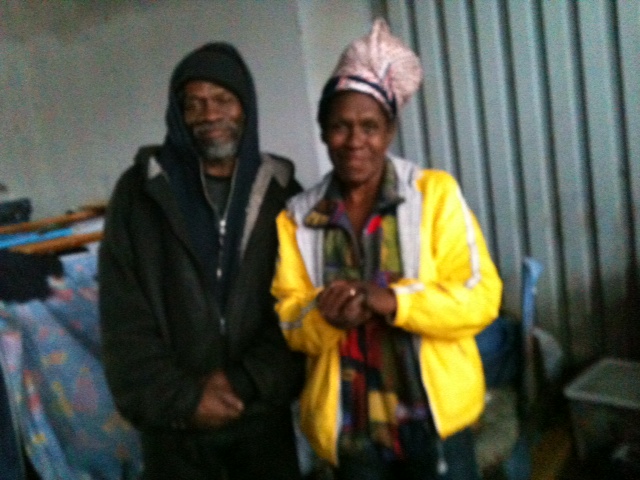
in the end we gave them the whole box and we asked for a photo. They were gracious enough to let us take
their picture which is now on the Open Cathedral website – we told them we
wanted to tell people about how folks lived on the streets and they wanted us
to tell the story. It was an experience in God’s time out of time. Then I went
home and made dinner for my kids – and watched the end of the football game
with them. And wondered in my heart what
it all means. I wonder what Mary did after the angel left. Did she get up and make dinner? Did she feel able to tell someone like her
own mother about her experience. Did she
feel humbled to find herself in God’s time?
I do. I am in awe of God’s time,
I feel afraid to go there, but I love it when I do. When I say yes to God’s invitation I feel afraid
that it is too big for me, but afterwards I am grateful for the moments in
Sacred Space and time. Being a person
for God in God’s time only takes the word “Yes”. Mary’s “yes” to unknown
circumstances and experiences, yes to certain heartbreak and unconditional
love.
What I have found in my beginning
relationship with Mary is the strength to say Yes to whatever God has in store
for me, a servant of the Lord. And I ask
Mary to give me courage by her ultimate example of grace and faith to help me
along the Way.
Amen.
Luke 1:26-38
Advent 4B
December 18, 2011
The Names of God
The Names of God
I am Who I Am, Holy Father,
Immortal, Jehovah, Source of All Blessing, Adonai, Invisible, Glorious, Alpha
and Omega, Supreme Being, Divine
Presence, Creator of the World, Theos, King of Kings, Lord of Hosts, Lord of
Light, Ancient of Days, Redeemer, God of Israel, God of Abraham and Sarah,
Deliverer, Yahweh, Holy Light, All Knowing, All seeing, Elohim, Mighty Warrior,
Eternal Father, Allah, Spirit of the Living God, Omnipotent, Lord of Space, The
Source, The Guide, Heavenly Father, Deus, God of Jacob, Breath, King Eternal,
Maker of Heaven and Earth, God our Maker, Three in One and One in Three, Great
God, Elaha, Creator Spirit, Shield, Fortress, Lord God Almighty, Divine Power, Comforter,Umma,
Mother, Father, Abba, Papa, Daddy.
Everything we relate to in our
world and in our lives has a name. Names
define objects and people; give us history or tell a story; show us how to
relate to whatever is being named. We
name our children after those we love, we name our pets after the way they
look, or their breed name, or something we love, some extension of ourselves.
My beautiful doggie, Freckles, was so named because of the many black spots she
had on the white part of her coat – and it was her personality, too. Like a freckled kid, happy, free. My daughters carry their Grandmothers’ names
– my mother was Janet and my mother-in-law was Gerrarda Maria. My daughter Christine is named Christine
Gerrada Maria – for a great aunt of mine who died young and for her paternal
grandmother, who died too soon. And
Christine has another name – she was called Eun Yeung by her foster mother in
Korea – it means pure blessing. Christine carries in her names memories and
hopes and lots of love. She’s a living anthropological study in human migration
–including her Swedish immigrant Great-Grand Aunt, her Dutch Grandmother and
her Korean birth names given her at the beginning of her life. Her names tell about her history, a little about
who loves her, where she has been, what is hoped for her, who she belongs to,.
Names are very very important. They define our relationships.
In Jewish thought, a name is also not just a random combination of sounds. Names conveys the nature and essence of the
thing named. They represents the history and reputation of the being named. The
first Name used for God in scripture is Elohim. The word is a masculine plural
of a word that looks feminine in the singular (Eloha).This is an ancient word
for God, gods, or powers. In current culture we mostly refer to God as a
masculine being. The earliest written
form of the Germanic word god comes from the 6th century CE and is
pronounced ǥuđan. It is generally agreed
by linguists that Gudan meant either "to call" or "to
invoke". The Germanic words for god were originally neuter that is, neither masculine or feminine—but during the spread of
Christianity to the Germanic people the word God took on a masculine context.
This gives us our first inkling of who or what God is. And that first idea is a
question – Is God male or female, or both, or neither.
What else do we know
about God? Generally, God is most
often thought of as the supernatural creator and overseer of the Universe. Theologians
from many different backgrounds agree to a few concepts of God: infinite
knowledge, unlimited power, presence everywhere in the world, perfect goodness
and eternal existence. No wonder we have
so many words and names for God. The
concept of God is too big to wrap our arms around. How is it possible to be in
relationship with someone so unimaginably omnipresent? Maybe that is why there are people who don’t
believe in the existence of God. It’s just too big a problem to figure out who
God is and how I am in relationship with him or her or them. Or some people want to be able to
scientifically prove that God exists.
One of the saddest people I have known is a scientist who I dated
briefly a long time ago. He tried so
many times to empirically prove the existence of God and failed. So he could not let himself believe, even
though he wanted to. So he was without a greater being and I think that was a
lonely thing for him. We often speak of God calling us – Just as the
Germanic meaning of God’s name means we
call to or invoke God. We feel God
calling to us and we call back. There is
no way to prove it, even though I know God calls to me as well as I know my own
name.
So we are in relationship with a supreme
being with many names who we cannot see or touch or taste or smell. But we can hear God’s call. That is not a small thing. What else do we
know about God? As Christians we believe that Jesus is God coming into the
world as a human being and that through knowing Jesus we have a chance to know
something about God. In the Gospel according to John we read: “In the beginning
was the Word and the Word was with God and the Word was God.” Here is another
name for God – The Word, in the form of Jesus who brings to us the Word of God.
John goes on to say ,”In him was life, and that life was the light of all
mankind. The light shines in the
darkness and the darkness has not overcome it.” Our relationship with Jesus is
about knowing the lightness and truth about God and being assured that that truth
will not be overcome.
In our Gospel reading today Jesus is not
happy about names that religious leaders of his time call themselves. Jesus tells us not to call anyone teacher,
rabbi or father because these are some of the names of God. The behavior of religious people who pretend
to be better than others offends Jesus because they act like they have the
inside track with God. They wear special religious clothing out in the street
and pray on the corners so everyone can see them. He says, “The scribes and the Pharisees sit on Moses’ seat; 3therefore, do whatever they teach
you and follow it; but do not do as they do, for they do not practice what they
teach. 4They tie up heavy burdens, hard to bear, and lay them on
the shoulders of others; but they themselves are unwilling to lift a finger to
move them. 5They do all their deeds to be seen by others; for they
make their phylacteries broad and their fringes long. 6They love to have the place of
honor at banquets and the best seats in the synagogues, 7and to be greeted with respect in
the marketplaces, and to have people call them rabbi.” It seems that these
people have forgotten that our relationship with God is like that of a child to
his or her father – a father who loves and cherishes them. I know that all human fathers are not like
this. God our Father is the ideal father
– one who loves and nurtures his or her children with the love of both a mother
and father. The child is innocent and
humble of heart. The child leans on God
and is protected and cared for. The
religious people Jesus is criticizing here -and in the following verses he
really lights into them – these people prevent others from coming to God the
Father by putting impossible barriers in their way – barriers like education,
or proper dress, or manners, or status of birth. These people are shut out by the rules and
regulations of the religious structures of Jesus’ time – and it makes Jesus
angry. Who are God the Father’s
children? Jesus says , “The greatest
among you will be your servant. For
those who exalt themselves will be humbled and those who humble themselves will
be exalted.” The Kingdom of God belongs to those who know God as the nurturing,
loving, caring parent and who humble themselves to serve in God’s kingdom in
the service of those who have become the least in society. Our Psalm today is a
recitation of many things that can go wrong for human beings – they wandered in
a wasteland, were hungry and thirsty, suffered in prison, were subjected to
bitter hard labor, lived in darkness, suffered affliction because of their
sins, and got lost at sea. But in every case, when the people called out to
God, God heard them and blessed them, filled them with food and drink, saved them
from the crashing waves, made cities for them to live in, freed the prisoners
and saved the people from the hand of
the foe. We come to church to praise our
loving God for all the good things God has done for us. The psalmist says, “The upright see and
rejoice but all the wicked shut their mouths. Let the one who is wise heed
these things and ponder the loving deeds of the Lord.” Let us pray. We thank you Lord God for all your good and
loving care for us. May we go and do
likewise to the least of your children. Amen.
Friday, July 29, 2011
The Soap Opera Continues...
And so the soap opera continues. Rev. Amber told us last week about Jacob who tricked his blind, old, father, Isaac, into giving him his brother’s blessing and inheritance. He did this by disguising his smooth body with a fur robe to imitate his brother’s hairy body. And his mother, Rebecca, was coaching him from the sidelines. Now we find that Jacob himself has fallen in love with the daughter of a man named Laban, a distant cousin. Her name is Rachel and she is the younger sister of Leah. Jacob wants Rachel for his wife and is willing to strike a bargain of labor in Laban’s fields for seven years to win his bride. After the seven years are up, the trickster is himself tricked – Laban dresses up the older daughter, Leah, as the bride and marries her to Jacob instead of Rachel. Jacob is, of course, outraged and demands to know what Laban is up to – and Laban says that they never marry off the second daughter before the first. You think he might have mentioned that seven years ago! So Jacob works seven more years for the beloved Rachel and so they were also married, both sisters to the same husband. Trouble and rivalry ensue. As the story continues, Rachel and Jacob have one son, named Joseph while Leah bore Jacob at least six sons and several daughters. We also remember the story of Joseph and his coat of many colors, and how he came to be sold into slavery by his jealous half brothers. Yet he lived to be the most important right-hand man to the Pharaoh in Egypt. From the unethical trickery of Jacob and his father-in-law came the saving grace of Joseph’s mystical intelligence and power. From small, petty, even evil acts, God created the power and grace of Joseph, who saved his family and people from starvation. God redeems the past and creates a future for God’s people.
In our Gospel for today, Jesus gives eight examples of God doing something surprising and redemptive: the tiny mustard seed becomes a tree large enough to shield and house many birds; the parable of the wheat and the weeds is explained to the disciples; the Kingdom of Heaven is compared to a treasure hidden in a field that is discovered by someone who hides the treasure and then purchases the field with joy; a merchant finds a pearl of such perfection and beauty that he sells everything he has and buys it; a large catch of fish is hauled in and separated into good and bad - Jesus even adds that this is what the angels will do at the end of the age to the evil and righteous! Jesus asks if the disciples understand and they say yes. And he adds, as the eighth parable, “Therefore every scribe who has been trained for the kingdom of heaven is like the mistress of a household who brings out of her treasure what is new and what is old.” This statement doesn’t seem to go with the other parables, does it? “Therefore every scribe who has been trained for the kingdom of heaven is like the mistress of a household who brings out of her treasure what is new and what is old.”
I think Paul gives us three clues in Romans that might enlighten the statement about the scribe and her treasure. Paul identifies three promises or maybe treasures that God has given us in this reading from Romans. The first is the guiding presence of the Holy Spirit with us: ” 26Likewise the Spirit helps us in our weakness; for we do not know how to pray as we ought, but that very Spirit intercedes with sighs too deep for words. 27And God, who searches the heart, knows what is the mind of the Spirit, because the Spirit intercedes for the saints according to the will of God.” The second promise is the gift of God’s gracious blessing to those who love him: “28 We know that all things work together for good for those who love God, who are called according to his purpose”. And then there is the third promise, the confidence Paul has in the unfailing presence of God in our lives – that God will not abandon God’s people ever. And he lists all the things that cannot and will not separate us from God. Not in the past, not in the future. Like Jacob and Joseph, like the scribe who brings out of her treasure to the Kingdom that which is old and that which is new, is God being faithful and present to his people old and new – past, present and future. God redeems the past and creates a future for God’s people.
For I am convinced
That neither life nor death nor angels nor principalities
Things present or things to come
Nor powers
Nor life nor death
Nor any other created thing
Will be able to separate us from the love of God
Which is in Christ Jesus our Lord.
Which is in Christ Jesus our Lord.
Many historians have observed that Jesus might have been identified as Christ, but Paul was the founder of Christianity. And this verse put to song could have been their theme song. Paul tells us today of his surety that even though it seems like things are not always going so well for the Early Christians, nothing will separate them or us from God’s unfailing love, no matter how perfect or imperfect we are. The story of the early centuries of Christianity is long, bloody and complicated - a seed of love and compassion planted among the first followers of Jesus grew in many directions and took various forms even from the beginning. Our namesake town, Antioch, was a chief center of early Christianity. Although the Romans had claimed it as one of their capitals earlier in the 1st century, the city had a large population of Jewish origin and attracted the earliest missionaries. Antioch is said to have been evangelized by Peter first and then later by Barnabas and Paul during Paul's first missionary journey. The converts in Antioch were the first to be called Christians. They were just one small branch of the large tree growing from the trunk and roots which were Jesus. Things did not always go smoothly in Antioch, there were varying opinions on many details of belief and doctrine. They fought, they tried to exclude those with opposing beliefs. They disagreed bitterly about including the gentiles in their congregations and what would be required for them to join. In the readings from Morning Prayer this week we have been following some of these accounts in the book of the Acts of the Apostles. Saturday’s reading was about a letter the folks in Jerusalem sent to the congregation in Antioch, encouraging them to include the gentiles and their culture in the Christian Way, sending out Paul and Barnabus for on-site support. Acts 15:“22Then the apostles and the elders, with the consent of the whole church, decided to choose men from among their members and to send them to Antioch with Paul and Barnabas. They sent Judas called Barsabbas, and Silas, leaders among the brothers, 23with the following letter: “The brothers, both the apostles and the elders, to the believers of Gentile origin in Antioch and Syria and Cilicia, greetings. 24Since we have heard that certain persons who have gone out from us, though with no instructions from us, have said things to disturb you and have unsettled your minds, 25we have decided unanimously to choose representatives and send them to you, along with our beloved Barnabas and Paul, 26who have risked their lives for the sake of our Lord Jesus Christ. 27We have therefore sent Judas and Silas, who themselves will tell you the same things by word of mouth.” The early Christian congregations were not without a great deal of conflict, but they believed that nothing could separate them from the love of God, and they encouraged each other and lived, loved, suffered and argued together. And the small seed that was the deep compassion of Christ grew to a large tree, large enough to shade the whole earth. God redeems the past and creates a future for God’s people.
For I am convinced
That neither life nor death nor angels nor principalities
Things present or things to come
Nor powers
Nor life nor death
Nor any other created thing
Will be able to separate us from the love of God
Which is in Christ Jesus our Lord.
Which is in Christ Jesus our Lord.
Amen.
In our Gospel for today, Jesus gives eight examples of God doing something surprising and redemptive: the tiny mustard seed becomes a tree large enough to shield and house many birds; the parable of the wheat and the weeds is explained to the disciples; the Kingdom of Heaven is compared to a treasure hidden in a field that is discovered by someone who hides the treasure and then purchases the field with joy; a merchant finds a pearl of such perfection and beauty that he sells everything he has and buys it; a large catch of fish is hauled in and separated into good and bad - Jesus even adds that this is what the angels will do at the end of the age to the evil and righteous! Jesus asks if the disciples understand and they say yes. And he adds, as the eighth parable, “Therefore every scribe who has been trained for the kingdom of heaven is like the mistress of a household who brings out of her treasure what is new and what is old.” This statement doesn’t seem to go with the other parables, does it? “Therefore every scribe who has been trained for the kingdom of heaven is like the mistress of a household who brings out of her treasure what is new and what is old.”
I think Paul gives us three clues in Romans that might enlighten the statement about the scribe and her treasure. Paul identifies three promises or maybe treasures that God has given us in this reading from Romans. The first is the guiding presence of the Holy Spirit with us: ” 26Likewise the Spirit helps us in our weakness; for we do not know how to pray as we ought, but that very Spirit intercedes with sighs too deep for words. 27And God, who searches the heart, knows what is the mind of the Spirit, because the Spirit intercedes for the saints according to the will of God.” The second promise is the gift of God’s gracious blessing to those who love him: “28 We know that all things work together for good for those who love God, who are called according to his purpose”. And then there is the third promise, the confidence Paul has in the unfailing presence of God in our lives – that God will not abandon God’s people ever. And he lists all the things that cannot and will not separate us from God. Not in the past, not in the future. Like Jacob and Joseph, like the scribe who brings out of her treasure to the Kingdom that which is old and that which is new, is God being faithful and present to his people old and new – past, present and future. God redeems the past and creates a future for God’s people.
For I am convinced
That neither life nor death nor angels nor principalities
Things present or things to come
Nor powers
Nor life nor death
Nor any other created thing
Will be able to separate us from the love of God
Which is in Christ Jesus our Lord.
Which is in Christ Jesus our Lord.
Many historians have observed that Jesus might have been identified as Christ, but Paul was the founder of Christianity. And this verse put to song could have been their theme song. Paul tells us today of his surety that even though it seems like things are not always going so well for the Early Christians, nothing will separate them or us from God’s unfailing love, no matter how perfect or imperfect we are. The story of the early centuries of Christianity is long, bloody and complicated - a seed of love and compassion planted among the first followers of Jesus grew in many directions and took various forms even from the beginning. Our namesake town, Antioch, was a chief center of early Christianity. Although the Romans had claimed it as one of their capitals earlier in the 1st century, the city had a large population of Jewish origin and attracted the earliest missionaries. Antioch is said to have been evangelized by Peter first and then later by Barnabas and Paul during Paul's first missionary journey. The converts in Antioch were the first to be called Christians. They were just one small branch of the large tree growing from the trunk and roots which were Jesus. Things did not always go smoothly in Antioch, there were varying opinions on many details of belief and doctrine. They fought, they tried to exclude those with opposing beliefs. They disagreed bitterly about including the gentiles in their congregations and what would be required for them to join. In the readings from Morning Prayer this week we have been following some of these accounts in the book of the Acts of the Apostles. Saturday’s reading was about a letter the folks in Jerusalem sent to the congregation in Antioch, encouraging them to include the gentiles and their culture in the Christian Way, sending out Paul and Barnabus for on-site support. Acts 15:“22Then the apostles and the elders, with the consent of the whole church, decided to choose men from among their members and to send them to Antioch with Paul and Barnabas. They sent Judas called Barsabbas, and Silas, leaders among the brothers, 23with the following letter: “The brothers, both the apostles and the elders, to the believers of Gentile origin in Antioch and Syria and Cilicia, greetings. 24Since we have heard that certain persons who have gone out from us, though with no instructions from us, have said things to disturb you and have unsettled your minds, 25we have decided unanimously to choose representatives and send them to you, along with our beloved Barnabas and Paul, 26who have risked their lives for the sake of our Lord Jesus Christ. 27We have therefore sent Judas and Silas, who themselves will tell you the same things by word of mouth.” The early Christian congregations were not without a great deal of conflict, but they believed that nothing could separate them from the love of God, and they encouraged each other and lived, loved, suffered and argued together. And the small seed that was the deep compassion of Christ grew to a large tree, large enough to shade the whole earth. God redeems the past and creates a future for God’s people.
For I am convinced
That neither life nor death nor angels nor principalities
Things present or things to come
Nor powers
Nor life nor death
Nor any other created thing
Will be able to separate us from the love of God
Which is in Christ Jesus our Lord.
Which is in Christ Jesus our Lord.
Amen.
Tuesday, July 5, 2011
Obedience

Obedience and Righteousness
There are two words in our readings for today that stuck in my head – obedience and righteousness. In our contemporary culture both of these words can have negative connotations, as self-determination and freedom of will are held in high regard in our society. Being obedient is accepting one’s submission to authority. Which can be negative or positive depending on the source of the authority. According to Roget’s Thesaurus some synonyms for obedience are: accordance, acquiescence, agreement, compliance, conformability, conformity, deference, docility, duteousness, dutifulness, duty, manageability, meekness, observance, orderliness, quietness, respect, reverence, servility, submission, subservience, tameness, tractability, willingness. We sometimes see traits like tractability and docility as signs of weakness or giving up or even depression.
Obedience. In Genesis God says to Abraham “…by your offspring shall all the nations of the earth gain blessing for themselves, because you have obeyed my voice.” Abraham obeyed God by his submission to God’s authority over him. He accepted and trusted God’s authority over him. He was obedient even to the very point of sacrificing his beloved long-awaited son Isaac. The antonyms or opposite of obedience are rebellion, bad behavior, disobedience, mischief, mutiny, and misbehavior. These are also some of the milder synonyms for the word sin. Is sin the opposite of obedience? I always think of sin as what stands between me and God – whatever actions, thoughts, attitudes, beliefs or feelings I have that prevent me from moving closer and closer to a full life in the Spirit. In the verses before our Gospel for today, Jesus says to his followers, “Whoever does not take his cross and follow me is not worthy of me”. A person can’t wait until he or she is free of the cross, the weight of our own sin, to follow Jesus with obedience and submission. We carry our own cross for the sake of love for Jesus. My cross is not my obedience to Jesus Christ. My cross is my own sin; whatever separates me from God. So it’s confession time. I find that my pride is one of the feelings that stands between me and God. Part of being obedient to God for me is not standing on my pride – oh so hard to do. Especially at work when my expertise is challenged, I will argue for my stand, for my knowledge and skill, on behalf of my staff, AND I will argue because I NEED to be RIGHT!!! And sometimes God’s way lives on the other side of my need to be right. Pride goeth before a fall; I know it well. My second confession is that I also feel self-righteous sometimes about being a rebel. The diaconate can attract folks who feel called to the fringe of society, as our call is to serve the poor, hungry, imprisoned, lonely, aged, sick and all others who stand outside the community. Jesus was considered a rebel or insurgent for taking this kind of stand so I can feel a certain amount of self-righteousness about my call to the marginalized. But this very stance about my sense of my own call is a sin for me. My potential self-righteous attitude about taking care of the poor can undermine any good that may come. It is a sin that stands between me and true life in God. Pride and self-righteousness are my cross to take up and carry on the journey to full life in Christ.
What about the other word that stuck in my head this week? Righteousness. I just used it negatively as self-righteousness. St. Paul, in his Letter to the Romans, says “thanks be to God that you, having once been slaves of sin, have become obedient from the heart to the form of teaching to which you were entrusted, and that you, having been set free from sin, have become slaves of righteousness.” Having once been a slave of sin, that is, submissive to my own pride, entrapped by my own self-righteousness, now I, by the grace of God, strive to become obedient from the heart to the form of teaching to which I was entrusted through my baptism – the teaching of Jesus. And that striving to be set free from sin by Jesus’ teaching, have become a slave of righteousness. Not a possessor of righteousness, but a slave to righteousness. Now when I looked up righteousness in the Thesaurus it was defined as devotion to a sinless life. Wikipedia says that righteousness is an attribute that implies that a person's actions are justified, and can have the connotation that the person has been "judged" or "reckoned" as leading a life that is pleasing to God. God “reckoned” Abraham’s faithful obedience to God as righteousness. And God asks the same slavery to right action and faith from us. Jesus says, in the verse just before our reading today in Matthew, that he who loses his life for Jesus’ sake will find it – giving up our lives we have justified ourselves and striving for a life justified by God.Jesus says, whoever welcomes you welcomes me, and whoever welcomes me welcomes the one who sent me. Whoever welcomes a prophet in the name of a prophet will receive a prophet's reward; and whoever welcomes a righteous person in the name of Jesus will receive the reward of the righteous… And that reward is being justified by God in our obedience. Sounds hard to me. And it is hard. For me it means not going to the stubborn place of pride when I’m challenged, but trusting that God will find a way to make things work. And it means not always having to be right, to be willing to listen to authority, not always having rebelliousness as my response to authority. Living in awareness of these attributes has become spiritual practice for me. It’s not easy for me. But when I can listen and not react, empty myself and not be full of pride, let go of my need to always be right - I feel something new, there is a new voice in my heart, and I know God is with me.
Let us pray:
Almighty God, whose beloved Son willingly endured the agony and shame of the cross for our redemption: Give us courage to take up our cross and follow him. Grant, Lord God, to all who have been baptized into the death and resurrection of your Son Jesus Christ, that as we strive to put away the old life of sin, so may we be renewed in the spirit of our minds, and live in righteousness and true holiness; through Jesus Christ our Lord, who lives and reigns with you, in the unity of the Holy Spirit, one God, now and for ever. Amen.
Genesis 22:1
There are two words in our readings for today that stuck in my head – obedience and righteousness. In our contemporary culture both of these words can have negative connotations, as self-determination and freedom of will are held in high regard in our society. Being obedient is accepting one’s submission to authority. Which can be negative or positive depending on the source of the authority. According to Roget’s Thesaurus some synonyms for obedience are: accordance, acquiescence, agreement, compliance, conformability, conformity, deference, docility, duteousness, dutifulness, duty, manageability, meekness, observance, orderliness, quietness, respect, reverence, servility, submission, subservience, tameness, tractability, willingness. We sometimes see traits like tractability and docility as signs of weakness or giving up or even depression.
Obedience. In Genesis God says to Abraham “…by your offspring shall all the nations of the earth gain blessing for themselves, because you have obeyed my voice.” Abraham obeyed God by his submission to God’s authority over him. He accepted and trusted God’s authority over him. He was obedient even to the very point of sacrificing his beloved long-awaited son Isaac. The antonyms or opposite of obedience are rebellion, bad behavior, disobedience, mischief, mutiny, and misbehavior. These are also some of the milder synonyms for the word sin. Is sin the opposite of obedience? I always think of sin as what stands between me and God – whatever actions, thoughts, attitudes, beliefs or feelings I have that prevent me from moving closer and closer to a full life in the Spirit. In the verses before our Gospel for today, Jesus says to his followers, “Whoever does not take his cross and follow me is not worthy of me”. A person can’t wait until he or she is free of the cross, the weight of our own sin, to follow Jesus with obedience and submission. We carry our own cross for the sake of love for Jesus. My cross is not my obedience to Jesus Christ. My cross is my own sin; whatever separates me from God. So it’s confession time. I find that my pride is one of the feelings that stands between me and God. Part of being obedient to God for me is not standing on my pride – oh so hard to do. Especially at work when my expertise is challenged, I will argue for my stand, for my knowledge and skill, on behalf of my staff, AND I will argue because I NEED to be RIGHT!!! And sometimes God’s way lives on the other side of my need to be right. Pride goeth before a fall; I know it well. My second confession is that I also feel self-righteous sometimes about being a rebel. The diaconate can attract folks who feel called to the fringe of society, as our call is to serve the poor, hungry, imprisoned, lonely, aged, sick and all others who stand outside the community. Jesus was considered a rebel or insurgent for taking this kind of stand so I can feel a certain amount of self-righteousness about my call to the marginalized. But this very stance about my sense of my own call is a sin for me. My potential self-righteous attitude about taking care of the poor can undermine any good that may come. It is a sin that stands between me and true life in God. Pride and self-righteousness are my cross to take up and carry on the journey to full life in Christ.
What about the other word that stuck in my head this week? Righteousness. I just used it negatively as self-righteousness. St. Paul, in his Letter to the Romans, says “thanks be to God that you, having once been slaves of sin, have become obedient from the heart to the form of teaching to which you were entrusted, and that you, having been set free from sin, have become slaves of righteousness.” Having once been a slave of sin, that is, submissive to my own pride, entrapped by my own self-righteousness, now I, by the grace of God, strive to become obedient from the heart to the form of teaching to which I was entrusted through my baptism – the teaching of Jesus. And that striving to be set free from sin by Jesus’ teaching, have become a slave of righteousness. Not a possessor of righteousness, but a slave to righteousness. Now when I looked up righteousness in the Thesaurus it was defined as devotion to a sinless life. Wikipedia says that righteousness is an attribute that implies that a person's actions are justified, and can have the connotation that the person has been "judged" or "reckoned" as leading a life that is pleasing to God. God “reckoned” Abraham’s faithful obedience to God as righteousness. And God asks the same slavery to right action and faith from us. Jesus says, in the verse just before our reading today in Matthew, that he who loses his life for Jesus’ sake will find it – giving up our lives we have justified ourselves and striving for a life justified by God.Jesus says, whoever welcomes you welcomes me, and whoever welcomes me welcomes the one who sent me. Whoever welcomes a prophet in the name of a prophet will receive a prophet's reward; and whoever welcomes a righteous person in the name of Jesus will receive the reward of the righteous… And that reward is being justified by God in our obedience. Sounds hard to me. And it is hard. For me it means not going to the stubborn place of pride when I’m challenged, but trusting that God will find a way to make things work. And it means not always having to be right, to be willing to listen to authority, not always having rebelliousness as my response to authority. Living in awareness of these attributes has become spiritual practice for me. It’s not easy for me. But when I can listen and not react, empty myself and not be full of pride, let go of my need to always be right - I feel something new, there is a new voice in my heart, and I know God is with me.
Let us pray:
Almighty God, whose beloved Son willingly endured the agony and shame of the cross for our redemption: Give us courage to take up our cross and follow him. Grant, Lord God, to all who have been baptized into the death and resurrection of your Son Jesus Christ, that as we strive to put away the old life of sin, so may we be renewed in the spirit of our minds, and live in righteousness and true holiness; through Jesus Christ our Lord, who lives and reigns with you, in the unity of the Holy Spirit, one God, now and for ever. Amen.
Genesis 22:1
Romans 6:12
Matthew 10:40
Monday, October 11, 2010
The Chasm

The Chasm
In the second year at the School for Deacons each student takes a class in Field Education at a facility such as a homeless shelter, a meal program, or a social service agency. I chose to spend 8 hours a week for a year at a local mental health inpatient facility called Crestwood. There are very few of these kinds facilities –after the dismantling of the large mental health institutions the intention was to create small, community based treatment centers for the mentally ill, but it has not happened the way it was envisioned. Now it is almost necessary that a mentally ill person without health insurance do something illegal to qualify for assessment and some kind of help. Many do not get help until they end up in prison, unfortunately.
When I started at Crestwood I didn’t know much of anything about these issues. Most of my pastoral experience had been in hospice care and though I knew some people who had mental health issues this area of life was outside my daily experience and concern. I was concerned to be sure, but I honestly had been put off the topic of mental healthcare by some overly enthusiastic preaching so I had mixed feelings about my placement at Crestwood. Initially I felt really awkward there like at the start of a new job. I didn’t know how to get into the bathroom as it was locked. I didn’t know which staff members would be friendly in helping me to start a group for the consumers, as they called the patients. I was pretty much left on my own to figure out how to get to know the consumers and start up a group of some kind. And I didn’t know how the consumers would behave or what they would expect from me, if anything. So the first day I sat in their TV room and tried to get some conversations going. It was really hard to find anyone who would talk with me but I managed to get into a game of pool and eventually learned some of their names. I didn’t think of there being a divide between the consumers and myself in the moment but the divide between us was wide and deep. They didn’t know or care why I was hanging around and though I wanted to learn more about their lives and offer spiritual care, I didn’t know how to start so I tried to be there and be present and open to whatever happened. Eventually the consumers got used to seeing me and I started a spiritual care group and found my way along. I knew most of all that the wind of Holy Spirit was pushing me forward into this particular divide.
Leaving Crestwood for a moment and let’s talk about our gospel reading. It’s hard to imagine a more dramatic and difficult warning to the rich of the earth. The author, Luke, who was a physician, was the likely author of both this Gospel and the Acts of the Apostles. He had a special affinity for the poor, the marginalized and for women. Luke holds with Jewish tradition that the poor are considered especially holy. This is the feeling we get about Lazarus who lies uncomplaining at the door of the rich man’s house, eating the scraps from his table, and letting dogs lick his sores for comfort. Because he is holy he is taken away by the angels when he dies to live with his Father, Abraham, in the joy of heaven. Now the rich man has had a lot of the good life in his times: nice clothes and home, good food and presumably good friends and family. Luke does not describe him as a selfish person and he makes no mention of his attitude or contributions to the poor. So we can’t assume he was indifferent to the poor, he might have even been very generous. When the rich man dies he goes to Hades and is in torment. He looks across the divide and sees Abraham and Lazarus in heaven and asks for just a sip of water to cool his tongue, but the divide is too great for Lazarus to cross over to provide even that moment of comfort. The tables have turned – the divide that the rich man allowed to exist in life on earth between himself and Lazarus was now separating them in the afterworld. The rich man may have been generous or not, we don’t know, but we do know that he didn’t open himself to cross over that divide between rich and poor, even a poor man living right on his doorstep. So the rich man, realizing too late the error of his ways, begs Abraham, in his despair, to send Lazarus from the dead to warn his brothers of the lesson he had learned. Again Abraham refused by saying, “If they do not listen to Moses and the prophets, neither will they be convinced if someone rises from the dead.” This is most likely a reference to Jesus and perhaps it’s Luke's response to questions early Christians had as to why Jesus did not reappear after his resurrection and warn everyone of the realities of life after death. Particularly because some of the Christians were starting to lose their focus from the early days when everyone had personal experience of Jesus. There is an attempt to provide this warning in our reading from The Letter to Timothy as well. We hear: “As for those who in the present age are rich, command them not to be haughty or to set their hopes on the uncertainty of riches, but rather on God who richly provides us with everything for our enjoyment. They are to be good, to be rich in good works and ready to share, thus storing up for themselves the treasure of a good foundation for the future, so that they may take hold of the life that really is life.” Take hold of the life that really is life. What is that? It is Life in the Kingdom of God – where nothings divides us from God and our sisters and brothers on earth. The Kingdom of God lives in our souls by the power of the Holy Spirit. The Holy Spirit moves us toward justice for the poor and marginalized through discernment of the Spirit. And when we feel where the Spirit is working we may support that movement of the Spirit to continue to create God’s Kingdom here on earth. So what about my struggle with the divide at Crestwood? Maybe you are wondering if I ever made it over. Yes and no. I met a woman there named Suzanne. Sometimes she came to my Spiritual Care group and sometimes she took communion with us – even though she was Jewish. Everyone was welcome at the table. She told me that she really was a “Judeo-Christian” and I said, so I am I. Unfortunately her illness was progressive and she became more and more tormented. She would moan and scream and make unbearable sounds of suffering sometimes, walking continuously up and down the halls. In her few clear moments she told me about her life before Crestwood. She had two children, and a husband and a life in Berkeley where she lived with her family. And in this moment I saw clearly, too, that she was very much like me. There wasn’t much difference between us – same age and demographics, children, ex-husband, desire for a “normal” if somewhat bohemian life; spiritual and seeking. The significant difference was that she had the horrible bad luck to be stricken with worsening mental illness at the change of life – and I didn’t. I wished I could give her even a week of my life to feel what it was like to walk free again and experience the normal life of work, church, grocery store, eating out, being at home with family and having “normal” problems. She had none of that any more, only the torture that lived in her mind. She let me cross over and experience her life and be in relationship with her for a few brief moments. Eventually she was completely lost to her illness and I am pretty sure she lives with Abraham now. This is a pretty extreme story I have chosen to tell. Jesus’ story about Lazarus and the rich man illustrates the point that separation from any of our fellow creatures divides us from the life that is really life. Because Suzanne’s behavior was out of the so usual I had a hard time getting myself over the divide at all because the tragedy of her life was hard to see. I knew that it could have easily been me living at Crestwood and her coming in to visit and provide care. That was a really difficult reality for me to imagine. The good news is that unlike the rich man who died not realizing that the divide even existed we have the opportunity to reach across the divide today thru working for justice for the poor, the sick and the marginalized. We do it, not to avoid Hades, but because this is how Jesus our Savior lived – reaching out to those who needed his help and love. And by being present to their suffering. By the grace of the Holy Spirit we may do the same and gain a glimpse of God’s mercy across the divide. Amen.
In the second year at the School for Deacons each student takes a class in Field Education at a facility such as a homeless shelter, a meal program, or a social service agency. I chose to spend 8 hours a week for a year at a local mental health inpatient facility called Crestwood. There are very few of these kinds facilities –after the dismantling of the large mental health institutions the intention was to create small, community based treatment centers for the mentally ill, but it has not happened the way it was envisioned. Now it is almost necessary that a mentally ill person without health insurance do something illegal to qualify for assessment and some kind of help. Many do not get help until they end up in prison, unfortunately.
When I started at Crestwood I didn’t know much of anything about these issues. Most of my pastoral experience had been in hospice care and though I knew some people who had mental health issues this area of life was outside my daily experience and concern. I was concerned to be sure, but I honestly had been put off the topic of mental healthcare by some overly enthusiastic preaching so I had mixed feelings about my placement at Crestwood. Initially I felt really awkward there like at the start of a new job. I didn’t know how to get into the bathroom as it was locked. I didn’t know which staff members would be friendly in helping me to start a group for the consumers, as they called the patients. I was pretty much left on my own to figure out how to get to know the consumers and start up a group of some kind. And I didn’t know how the consumers would behave or what they would expect from me, if anything. So the first day I sat in their TV room and tried to get some conversations going. It was really hard to find anyone who would talk with me but I managed to get into a game of pool and eventually learned some of their names. I didn’t think of there being a divide between the consumers and myself in the moment but the divide between us was wide and deep. They didn’t know or care why I was hanging around and though I wanted to learn more about their lives and offer spiritual care, I didn’t know how to start so I tried to be there and be present and open to whatever happened. Eventually the consumers got used to seeing me and I started a spiritual care group and found my way along. I knew most of all that the wind of Holy Spirit was pushing me forward into this particular divide.
Leaving Crestwood for a moment and let’s talk about our gospel reading. It’s hard to imagine a more dramatic and difficult warning to the rich of the earth. The author, Luke, who was a physician, was the likely author of both this Gospel and the Acts of the Apostles. He had a special affinity for the poor, the marginalized and for women. Luke holds with Jewish tradition that the poor are considered especially holy. This is the feeling we get about Lazarus who lies uncomplaining at the door of the rich man’s house, eating the scraps from his table, and letting dogs lick his sores for comfort. Because he is holy he is taken away by the angels when he dies to live with his Father, Abraham, in the joy of heaven. Now the rich man has had a lot of the good life in his times: nice clothes and home, good food and presumably good friends and family. Luke does not describe him as a selfish person and he makes no mention of his attitude or contributions to the poor. So we can’t assume he was indifferent to the poor, he might have even been very generous. When the rich man dies he goes to Hades and is in torment. He looks across the divide and sees Abraham and Lazarus in heaven and asks for just a sip of water to cool his tongue, but the divide is too great for Lazarus to cross over to provide even that moment of comfort. The tables have turned – the divide that the rich man allowed to exist in life on earth between himself and Lazarus was now separating them in the afterworld. The rich man may have been generous or not, we don’t know, but we do know that he didn’t open himself to cross over that divide between rich and poor, even a poor man living right on his doorstep. So the rich man, realizing too late the error of his ways, begs Abraham, in his despair, to send Lazarus from the dead to warn his brothers of the lesson he had learned. Again Abraham refused by saying, “If they do not listen to Moses and the prophets, neither will they be convinced if someone rises from the dead.” This is most likely a reference to Jesus and perhaps it’s Luke's response to questions early Christians had as to why Jesus did not reappear after his resurrection and warn everyone of the realities of life after death. Particularly because some of the Christians were starting to lose their focus from the early days when everyone had personal experience of Jesus. There is an attempt to provide this warning in our reading from The Letter to Timothy as well. We hear: “As for those who in the present age are rich, command them not to be haughty or to set their hopes on the uncertainty of riches, but rather on God who richly provides us with everything for our enjoyment. They are to be good, to be rich in good works and ready to share, thus storing up for themselves the treasure of a good foundation for the future, so that they may take hold of the life that really is life.” Take hold of the life that really is life. What is that? It is Life in the Kingdom of God – where nothings divides us from God and our sisters and brothers on earth. The Kingdom of God lives in our souls by the power of the Holy Spirit. The Holy Spirit moves us toward justice for the poor and marginalized through discernment of the Spirit. And when we feel where the Spirit is working we may support that movement of the Spirit to continue to create God’s Kingdom here on earth. So what about my struggle with the divide at Crestwood? Maybe you are wondering if I ever made it over. Yes and no. I met a woman there named Suzanne. Sometimes she came to my Spiritual Care group and sometimes she took communion with us – even though she was Jewish. Everyone was welcome at the table. She told me that she really was a “Judeo-Christian” and I said, so I am I. Unfortunately her illness was progressive and she became more and more tormented. She would moan and scream and make unbearable sounds of suffering sometimes, walking continuously up and down the halls. In her few clear moments she told me about her life before Crestwood. She had two children, and a husband and a life in Berkeley where she lived with her family. And in this moment I saw clearly, too, that she was very much like me. There wasn’t much difference between us – same age and demographics, children, ex-husband, desire for a “normal” if somewhat bohemian life; spiritual and seeking. The significant difference was that she had the horrible bad luck to be stricken with worsening mental illness at the change of life – and I didn’t. I wished I could give her even a week of my life to feel what it was like to walk free again and experience the normal life of work, church, grocery store, eating out, being at home with family and having “normal” problems. She had none of that any more, only the torture that lived in her mind. She let me cross over and experience her life and be in relationship with her for a few brief moments. Eventually she was completely lost to her illness and I am pretty sure she lives with Abraham now. This is a pretty extreme story I have chosen to tell. Jesus’ story about Lazarus and the rich man illustrates the point that separation from any of our fellow creatures divides us from the life that is really life. Because Suzanne’s behavior was out of the so usual I had a hard time getting myself over the divide at all because the tragedy of her life was hard to see. I knew that it could have easily been me living at Crestwood and her coming in to visit and provide care. That was a really difficult reality for me to imagine. The good news is that unlike the rich man who died not realizing that the divide even existed we have the opportunity to reach across the divide today thru working for justice for the poor, the sick and the marginalized. We do it, not to avoid Hades, but because this is how Jesus our Savior lived – reaching out to those who needed his help and love. And by being present to their suffering. By the grace of the Holy Spirit we may do the same and gain a glimpse of God’s mercy across the divide. Amen.
Wednesday, August 18, 2010
Prophets
Over the past several thousand years there have been people called prophets who speak for justice and mercy at various times in various ways. Some were respected in their communities and some had to run for their lives. The first deacon, Stephen, in his inaugural sermon, spoke passionately with a prophetic voice. This disturbed some in the synagogue so much that despite all the wonders and signs he had done among the people, he was taken to the town square and stoned to death. Speaking up against social injustice and holding society accountable for the poverty and isolation of some members of the human race, makes the life of a prophet uncomfortable if not downright dangerous. But we need prophets in our midst, to keep us from growing comfortable in our lives and to shake up our complacency and send us out to work in the world for those who have no power to speak for themselves. Such a prophet is a deacon friend of mine, someone who I went to school with. She holds a Ph.D. in political science and was a naval officer. She speaks with a prophetic voice that is hard to hear sometimes, because she calls us out to care about places and situations far away from our daily lives. Recently she wrote a short note in the Deacons’ yahoo group messages about the privatization of water in the countries of Bolivia and Peru by large companies such as coca cola – making access to something as basic to life as water a political and economic issue. I find myself resisting the reality of the challenge in her words. The resistance is the key – because it will cost me something to care about this problem. I might have to take action, make a choice, care enough to do something. It’s hard to listen to the call to justice in the middle of a busy life. But that’s what Christians are called to do. We are called at the very least to be aware and pray and care.
We are so blessed in our lives, to have Bishops who speak fearlessly about the times in which we live. They are also prophets. They speak out despite the division their visions of Life in the Kingdom bring. On July 25th, Presiding Bishop Katharine Jefferts Schori attended a Eucharist at St. Paul's Cathedral in London. She challenged those present to be "ready, willing and able" to speak out and take action against the world's injustices and indignities. She said, "Prophetic work is about more abundant life for the whole world, and it is about a home everywhere, a home for all," she said during her sermon. "Prophetic work is about challenging human systems that ignore or deny the innate dignity of all of God's creation … We lose our dignity when we tolerate indignity for some … The work of the cross is the most life-giving journey we know. Are you ready, willing and able?"
One of the ongoing controversies of our time is the right of gay and lesbian people to marry. As you are aware this was denied by proposition 8, voted in by the people of California last year. Last week a judge reversed this proposition, saying that denying the right to marry on the basis of sexual orientation was unconstitutional. Our own Bishop Marc, a true prophet, addressed the people who gathered at City Hall in San Francisco after the ruling and he said:"So, today Jesus says to you, 'Congratulations, you who have been mourning! You are being comforted! Congratulations all of you who have been hungering and thirsting for righteousness! Aren't you feeling filled and nourished now?' . . . All these congratulations and blessings are so that we can keep on moving, to extend congratulations to LGBT people in places where persecution is still intense, to use our great energies to help children get food and education, to give strength and support to women everywhere, to fight world-class diseases like HIV/AIDS, to heal the wounded planet. We rejoice today, and tomorrow we continue the fight, lending our strength, the blessing of God, to those who need it." This is what prophets do – speak out about the injustices of the times and hold the people accountable for changing the source of the injustice: and they do so at their own risk. I know that just by reading these quotes I may have caused division and anger in this very room. It is not comfortable to be a Christian and Jesus says that’s what he intends for his disciples. He didn’t come to make us happy or create a life of self-righteous ease. He came to bring fire and cause division! In our gospel reading today Jesus speaks with this prophetic voice to the disciples. They are continuing on the road to Jerusalem and in parable after parable Jesus explains that they must stay awake for what is coming. They must prepare for his death and to take his place in the world as prophets themselves, speaking truth to power and paying the price for speaking truth to power. In the chapters before today’s reading Jesus talks about being dressed and ready for action, having the lamps lit and the food ready for the master. He talks about the thief coming at an unexpected hour just as the Son of Man will come, like a thief in the night, when you are unarmed and unprepared. Jesus tells them the story of the unfaithful servant who, when put in charge, beats the other slaves and proceeds to get drunk – but then the master arrives at an unexpected hour and finds the servant unprepared and having abused his master’s trust. This was a warning to the disciples and also is a warning to us – to give up our complacency and work for the cause of the Kingdom. Jesus says, “From everyone to whom much has been given, much will be required; and from the one to whom much as been entrusted, even more will be demanded.” And then he demands, “do you think I have come to bring peace to the earth?” Well, yes, that is what we thought. What about Jesus’ birth and all the songs about “Peace on Earth good will to men”, and the angel going around telling everyone not to be afraid? What about Jesus’ mother Mary declaring that in Jesus’ very existence on earth the powerful had been brought down and the lowly lifted up, the hungry filled with good things and the rich sent away empty? What about the Kingdom where the lion will lie down with the lamb? Why did Jesus come here to earth, then? To make more trouble in an already troubled time, to cause division and bring fire to the earth? Yes, he says. He knows that he is going to his “baptism” of fire in Jerusalem and he feels stressed out that the disciples don’t understand that he will soon be gone and all hell will break loose for his followers. Those who take up the cross that they will bear for the sake of the love of Jesus will suffer greatly and live with division, even in their own families. Because they live a life outside the norm – not going along or giving in to the pressures of society and industry, but protesting and speaking out for the sake of the marginalized and suffering poor of the world. In our reading from the letter of Paul to the Hebrews, Paul recites an extensive list of the sufferings of the prophets and then says, “ 12Therefore, since we are surrounded by so great a cloud of witnesses, let us also lay aside every weight and the sin that clings so closely, and let us run with perseverance the race that is set before us, 2looking to Jesus the pioneer and perfecter of our faith, who for the sake of the joy that was set before him endured the cross, disregarding its shame, and has taken his seat at the right hand of the throne of God.” The sin that Paul refers to as clinging closely to us is that which separates us from God – the unwillingness to take a chance and step out in favor of those who have no voice or support or the rights that all human beings deserve. This is what I meant when I said I find myself resisting the reality of the challenge. In order to be ready for the Master I need to give up my own resistance to change – the sin that separates me from God and open my ears to the prophetic word. As Theologian Walter Bruggemann says, it is “crunch” time. Crunch time is the time to make a decision for or against the Holy Reign of God. The prophets and martyrs of old made their choices with joy. Jesus, Paul says, made his choice with joy, and Bp. Katherine says . "We're invited to join the band of prophets, share the meal and drink the cup. It can be dangerous work, but most prophets I know are also filled with joy."
This, I know, is a lot to take in. We are not all called to be prophets or speak with a prophetic voice. But we are all called as Christians to listen, respond and be present to the difficult choices life presents us. And to take be aware of the suffering near to us and across the world and take action to help those in need. Because we have been blessed. This is a daily choice we make – to live like Christ and share his vision. May God give us the insight and strength to hear the prophet’s voice. Amen.


We are so blessed in our lives, to have Bishops who speak fearlessly about the times in which we live. They are also prophets. They speak out despite the division their visions of Life in the Kingdom bring. On July 25th, Presiding Bishop Katharine Jefferts Schori attended a Eucharist at St. Paul's Cathedral in London. She challenged those present to be "ready, willing and able" to speak out and take action against the world's injustices and indignities. She said, "Prophetic work is about more abundant life for the whole world, and it is about a home everywhere, a home for all," she said during her sermon. "Prophetic work is about challenging human systems that ignore or deny the innate dignity of all of God's creation … We lose our dignity when we tolerate indignity for some … The work of the cross is the most life-giving journey we know. Are you ready, willing and able?"
One of the ongoing controversies of our time is the right of gay and lesbian people to marry. As you are aware this was denied by proposition 8, voted in by the people of California last year. Last week a judge reversed this proposition, saying that denying the right to marry on the basis of sexual orientation was unconstitutional. Our own Bishop Marc, a true prophet, addressed the people who gathered at City Hall in San Francisco after the ruling and he said:"So, today Jesus says to you, 'Congratulations, you who have been mourning! You are being comforted! Congratulations all of you who have been hungering and thirsting for righteousness! Aren't you feeling filled and nourished now?' . . . All these congratulations and blessings are so that we can keep on moving, to extend congratulations to LGBT people in places where persecution is still intense, to use our great energies to help children get food and education, to give strength and support to women everywhere, to fight world-class diseases like HIV/AIDS, to heal the wounded planet. We rejoice today, and tomorrow we continue the fight, lending our strength, the blessing of God, to those who need it." This is what prophets do – speak out about the injustices of the times and hold the people accountable for changing the source of the injustice: and they do so at their own risk. I know that just by reading these quotes I may have caused division and anger in this very room. It is not comfortable to be a Christian and Jesus says that’s what he intends for his disciples. He didn’t come to make us happy or create a life of self-righteous ease. He came to bring fire and cause division! In our gospel reading today Jesus speaks with this prophetic voice to the disciples. They are continuing on the road to Jerusalem and in parable after parable Jesus explains that they must stay awake for what is coming. They must prepare for his death and to take his place in the world as prophets themselves, speaking truth to power and paying the price for speaking truth to power. In the chapters before today’s reading Jesus talks about being dressed and ready for action, having the lamps lit and the food ready for the master. He talks about the thief coming at an unexpected hour just as the Son of Man will come, like a thief in the night, when you are unarmed and unprepared. Jesus tells them the story of the unfaithful servant who, when put in charge, beats the other slaves and proceeds to get drunk – but then the master arrives at an unexpected hour and finds the servant unprepared and having abused his master’s trust. This was a warning to the disciples and also is a warning to us – to give up our complacency and work for the cause of the Kingdom. Jesus says, “From everyone to whom much has been given, much will be required; and from the one to whom much as been entrusted, even more will be demanded.” And then he demands, “do you think I have come to bring peace to the earth?” Well, yes, that is what we thought. What about Jesus’ birth and all the songs about “Peace on Earth good will to men”, and the angel going around telling everyone not to be afraid? What about Jesus’ mother Mary declaring that in Jesus’ very existence on earth the powerful had been brought down and the lowly lifted up, the hungry filled with good things and the rich sent away empty? What about the Kingdom where the lion will lie down with the lamb? Why did Jesus come here to earth, then? To make more trouble in an already troubled time, to cause division and bring fire to the earth? Yes, he says. He knows that he is going to his “baptism” of fire in Jerusalem and he feels stressed out that the disciples don’t understand that he will soon be gone and all hell will break loose for his followers. Those who take up the cross that they will bear for the sake of the love of Jesus will suffer greatly and live with division, even in their own families. Because they live a life outside the norm – not going along or giving in to the pressures of society and industry, but protesting and speaking out for the sake of the marginalized and suffering poor of the world. In our reading from the letter of Paul to the Hebrews, Paul recites an extensive list of the sufferings of the prophets and then says, “ 12Therefore, since we are surrounded by so great a cloud of witnesses, let us also lay aside every weight and the sin that clings so closely, and let us run with perseverance the race that is set before us, 2looking to Jesus the pioneer and perfecter of our faith, who for the sake of the joy that was set before him endured the cross, disregarding its shame, and has taken his seat at the right hand of the throne of God.” The sin that Paul refers to as clinging closely to us is that which separates us from God – the unwillingness to take a chance and step out in favor of those who have no voice or support or the rights that all human beings deserve. This is what I meant when I said I find myself resisting the reality of the challenge. In order to be ready for the Master I need to give up my own resistance to change – the sin that separates me from God and open my ears to the prophetic word. As Theologian Walter Bruggemann says, it is “crunch” time. Crunch time is the time to make a decision for or against the Holy Reign of God. The prophets and martyrs of old made their choices with joy. Jesus, Paul says, made his choice with joy, and Bp. Katherine says . "We're invited to join the band of prophets, share the meal and drink the cup. It can be dangerous work, but most prophets I know are also filled with joy."
This, I know, is a lot to take in. We are not all called to be prophets or speak with a prophetic voice. But we are all called as Christians to listen, respond and be present to the difficult choices life presents us. And to take be aware of the suffering near to us and across the world and take action to help those in need. Because we have been blessed. This is a daily choice we make – to live like Christ and share his vision. May God give us the insight and strength to hear the prophet’s voice. Amen.
Sunday, July 11, 2010
Samaritans
 I want to tell you a true story that I wish wasn’t true. A few years ago I joined with the folks who were participating in the Episcopal Charities Walk in San Francisco. If you haven’t heard of this, it’s a sponsored walk to raise money for various Episcopal charities around SF and in Oakland as well. The participants walk from site to site, learning about each charity they visit and taking on some pretty steep hills as part of the journey. So we set off from the Cathedral with the Bishop in the lead. The first leg of the walk was straight down from the Cathedral into the Tenderloin district, where there are lots of people who have life challenges to put it mildly. In the first block we passed some folks sitting drinking on a stoop. One of the men, he looked more like an older boy really, had passed out on the sidewalk and was lying with his leg half in the street and just spread out there in our path. Several dozen Episcopalian walkers had already passed by and so we came up behind them and saw the man lying there, too. We discussed what should be done, in our little group, and because we felt obligated to proceed with the walk we had signed up to do, and because we presumed that someone had already called police or ambulance, we continued on with the walk. We visited all the charitable organizations that do such great work in SF and we wore ourselves out trudging up and down the hills, but I couldn’t get that unconscious man out of my head, lying splayed out on the sidewalk, stone cold drunk and helplessly unconscious. Who was a neighbor to this man? Certainly not a couple hundred Episcopalians who walked right past – I know many had more than a tug at their heart and compassion – but I hated it that I was one of them and that I didn’t stop and do something to change that moment in time for him. Did he deserve my help and pity? I believe he did, I believe he did. Was I legally obliged to act? I don’t know. God put a tug in my heart, and I walked by. I was not a neighbor to the man who lay drunk and unconscious on the sidewalk. I wish I didn’t have this story to tell you.
In our Gospel today a lawyer asks Jesus a legal question about his rights and obligations as a Jewish citizen and religious adherent in the first century. “What must I do to inherit eternal life?” And Jesus questions him back – “What does the law say? What do you read there? They are both referring to the Jewish law contained in the Torah, the first five books of the Jewish Scriptures. The lawyer replies with the standard and proper response: “You shall love the Lord your God with all your heart, and with all your soul, and with all your strength, and with all your mind; and your neighbor as yourself.” 28And then Jesus says to him, “You have given the right answer; do this, and you will live.” But the lawyer feels some kind of dismissal in this interchange – He has given the pat answer and Jesus has responded in a perfunctory way. So to push the envelope a little the lawyer asks, and who IS my neighbor? And so Jesus invites him and us then, into a deeper more loving more intimate meaning of the word neighbor. The question changes from a legal issue to a loving issue – not “who is my neighbor?” but “who was a neighbor to the man who was injured?” These are completely different questions by legal standards and by standards of the heart. Legally, the priest and the Levite could not touch the beaten man who had been left in the ditch to die, they could not touch him according to Jewish law, without losing their status of ritual cleanliness. And then they could not perform the acts they were obligated to perform on behalf of the people at the temple. So they passed on by due to this question of legal and religious obligation – and they were legally right to do so. But the question of the heart, the question of love begs a different response. The Samaritan looks at the man and is filled with pity for his condition – he doesn’t worry about his own consequences or the cost, or the interruption of his journey – he is filled with pity and acts accordingly. And Jesus casts this helper as a Samaritan just to put a knife into the heart of the lawyer, because as we have discussed previously the Samaritans were the enemies of the Jews and did not follow the Jewish laws and dared to worship at another temple on another mountain. Justice can certainly be a question of law – just and right behavior can be regulated and receive a stamp of approval. But mercy on the other hand, is an affair of the heart. Who is a neighbor to the injured one, who is moved with enough compassion to do something to really help?
The lawyer asks: And who is my neighbor?
And Jesus answers: Who was a neighbor to the man who fell into the hands of the robbers?
So to answer this question I have to tell you another story and ask another question.
As many of you know, I work in a small rural hospital about 70 miles from here. Our hospital has been struggling financially as long as I have worked there, about 10 years. And though the problems – financial, structural and social – are abundant, there is compassion and care in the work done there. The town also has a lot of pride in its produce – and in its name, which is famous all over the world, though the town is very small. Over the past nine months many ideas have been considered to keep the hospital from falling into bankruptcy as many small hospitals do. This week a new idea, which had been floating around for a while, was made public. There is a state mental hospital nearby and our hospital is considering a contract with them to provide acute hospital care for the residents and prisoners. It will bring needed revenue for the hospital, much needed revenue. Our usual clientele mix ranges from the extremely wealthy and sometimes famous to the most poor and illegal field worker. There is no security to speak of at the hospital. The doors are open most of the time except in the dark of night and we have no security guard at any time of day or night. So this is the setting into
which a few very mentally ill and criminally culpable individuals with serious healthcare issues are proposed to be introduced. I wondered how my staff of nutrition caregivers would respond. I wondered how they would feel about the prisoners and their guardians being in our hospital and providing care for them. At 11:45 each weekday we have a “standup” meeting for about 5 minutes so I took the opportunity on Friday to ask them how they felt about the potential for the criminally insane to be patients in the hospital. Nobody answered so I went ahead and talked about how it would be normal to be afraid of working with folks who have committed a crime serious enough to land them in the state hospital. But fortunately, this state hospital is the same place where I did my clinical pastoral education for SFD and so I could assure them that medication, guards and psych techs will control the behavior of the prisoners so that my staff can feel very safe – and when the prisoners come to the hospital they will be sick enough to be admitted to an acute hospital – for whatever regular reasons people are admitted – appendicitis, broken legs or hips, surgery of some kind, even having a baby.
Referring back to our story about the Good Samaritan, one could argue that these prisoners are not the man who was beaten and stripped of his clothing and left to die by the side of the road. They are, in fact, the robbers. They have beaten and stolen and murdered. They have exhibited out-of-control dangerous behavior. They are unwashed and unkempt, in dirty clothes and smelling not so great. They are our neighbors, brothers and sisters, they are us. We may have folks in our own families with mental illness – perhaps not so extreme – but although we don’t talk about it much, mental health care is a huge problem in our society – most people with severe mental illness end up in prison since the large institutions were shut down. Don’t get me started….
Jesus asked, who was a neighbor to the man who injured by the robbers? The lawyer answered, the one who showed him mercy.
And I want to ask the question - will we at the small rural hospital be able to be the neighbor to the robber himself – to the most despicable, dirty, criminal and ultimately the most in need of our love and care? Will we be able to show him or her mercy? It is my prayer that this blessing will come our way. Jesus says, Go and do likewise.
Amen.
Subscribe to:
Posts (Atom)